
Combating invasives
Effort in Baraga County this week
Trending
BARAGA COUNTY -- The Superior Watershed Partnership and Land Conservancy (SWP) announced the launch of its Great Lakes Climate Corps (GLCC) and Great Lakes Tribal Conservation Corps (GLTCC) field season.
Tyler Penrod, SWP's GLCC Program Manager, said SWP has several projects ongoing throughout the Upper Peninsula this season, including projects in Baraga County.
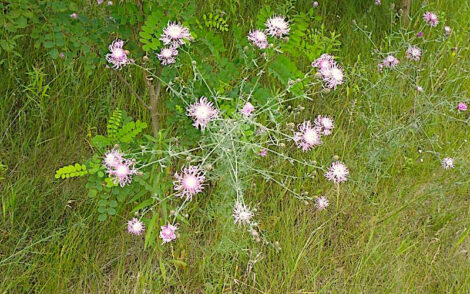
This week, SWP's Great Lakes Tribal Conservation Corps (GLTCC) is working to remove invasive species, including spotted knapweek, at various sites in L'Anse and Baraga.
"It is a pretty nasty invasive species with a little purple flower, but its roots release a toxin into the soil that prevents other plants from growing where it grows," said Penrod.
According to the Michigan Department of Agriculture and Rural Development (MDARD), Spotted knapweed is a native of Europe and Asia. It was introduced to North America in the 1890s as a contaminant in agricultural seed and through soil discarded from ship ballast. It has become a serious problem of pastures and range land in the western United States and is spreading eastward from Minnesota.
It is highly invasive and, therefore, can severely decrease the biological diversity of native and agronomic habitats by reducing the availability of desirable forage for livestock operations, says MDARD. It also degrades wildlife habitats, hindering reforestation and landscape restoration efforts. It also produces a chemical that is toxic to other plants, allowing it to spread quickly and become established.
Penrod said that today, it is spread largely by human activity.
"The seeds can spread by ATV tires, in the treads of boots, but a lot of times," he said, "it is seen in disturbed or sandy areas, especially along beaches and shorelines."
Penrod said SWP crews are working with the KBIC Natural Resources Department to remove plants several sites around KBIC.
Penrod said there are several effective ways of removing invasive plant species. While one way is through chemical herbicide application, Penrod said SWP relies on manual removal.
Persistent hand-pulling and digging may be practical on small patches, MDARD says. Hand-pulling alone can be effective in sandier soils. Dig out and remove as much of the long tap root as possible. Regular site check-ups are required to ensure that re-sprouting and new seedlings are destroyed.
"Our crews are out there pulling the plants by the roots, then either sun-dry it to kill it, or we'll bag it up for disposal."
Penrod said there are several projects lined up this summer.
"We're going to have our Great Lakes Tribal Conservation Corps working in the area quite a bit this summer. We'v got beach grass planting projects there; we're going to be doing plantings of native species - wildflowers, shrubs and trees."
The Superior Watershed Partnership is a nonprofit organization, based in Marquette, that connects students to their local watershed through engaging STEAM-based projects (Science, Technology, Engineering, Art, Math), from habitat restoration to solar energy. The Superior Watershed Partnership helps build environmental literacy, well-being, and stewardship.