
A Great Lakes legacy
Salmon fishing in the St. Mary\'s
Trending
SAULT STE. MARIE - Most avid anglers can only dream about the exotic places where they would love to land their next big fish.
Richard Barch, of Tecumseh, Mich. is one of those lucky outdoorsmen who has been able to fish and hunt in many places around the world, including some of these remote fishing areas, and beyond. He says his favorite hunting trip was years ago in Iran with Shah Mohammad Reza Pahlavi's brother, Abdul.
But it was on a trip closer to home over 20 years ago, fishing for Atlantic salmon in the St. Mary's River at Sault Ste. Marie, that he learned about Lake Superior State University's program in support of the fierce-fighting Atlantics. He was hooked.
An avid fly fisherman, Barch especially enjoys fishing for Atlantic salmon and steelhead, two species that are commonly found in the St. Mary's River rapids and other streams nearby. He said what he found at Sault Ste. Marie rivaled and even surpassed the fishing in those storied places of the North Atlantic.
"There's a lot of casting for Atlantics but very little catching in those places," Barch said of Nova Scotia, Quebec and Scotland. "The true Atlantics in the ocean are definitely having a hard time."
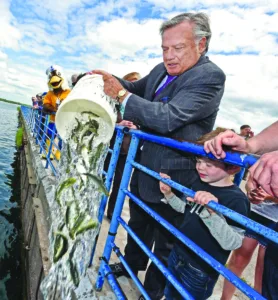
Not so in the St. Mary's River and northern Lake Huron, where Atlantic salmon have been holding their own since LSSU started planting them from its Aquatic Research Laboratory hatchery that was primarily built by students, staff (and a lot of duct tape). The facility opened in 1977 in a small space of the Edison Sault Electric (now Cloverland Electric Cooperative) hydroelectric plant on the St. Mary's River. The Atlantic salmon program came nearly 10 years later and just celebrated its 40th anniversary of stocking Atlantics this June.
Barch's passion for fishing for Atlantic salmon eventually led to his support for the new Center for Freshwater Research and Education (CFRE), which is an 18,000 sq. ft., $14.2 million facility named after Barch and his wife, Theresa. The center opened in December 2021, adjacent to the hatchery, with expanded research opportunities for students in not only the Atlantic salmon program, but in experiential learning opportunities around Great Lakes science and education.
In February, the Barch family donated an additional $3 million to CFRE, ensuring even more opportunities for students and expansion of research partnerships with a variety of agencies to study Great Lakes issues. The investment supports the creation of the Richard and Theresa Barch Endowed Executive Directorship, the first named directorship in the university's history, and it established a fund to support student research, as well as acquisition of state-of-the-art equipment, including a new research vessel.
The donation brings the total to $5.5 million that the Barch family has provided to CFRE, with the first $2.5 providing a challenge grant when CFRE was being constructed. In honor of their support, LSSU named the center after Richard and Theresa.
"Donations like these from the Barch family to a small university like LSSU are a game-changer for us," said Ashley Moerke, Barch CFRE Executive Director and dean of the LSSU College of Great Lakes Ecology and Education. "Their impact is immediately measurable and allows us to expand our mission by providing meaningful student training opportunities, K-12 community and education outreach programs, and contribute to research that is vital for the conservation of fisheries and Great Lakes resources.The commitment of Dick and Theresa creates critical financial stability to help sustain this work for generations to come."
Moerke said LSSU has long been known for programs that allow undergraduate students to engage directly in field and lab work, as well as participate in research studies that have a direct impact on the health of the Great Lakes. It was the potential for student involvement in real-world research that attracted Dick to CFRE after that first fishing trip many years ago.
"LSSU gives students an experience most other universities can't offer," he said. "The university provides an opportunity for hands-on work in the outdoors that a classroom or textbook can't replicate. Turning over rocks in a river or along a lake bottom brings a kind of personal satisfaction that deepens learning and reveals the complexity of ecosystems. Getting wet, cold, and muddy in waders is a defining part of the LSSU student experience, and one you won't find in an urban campus setting."
In recent years, Barch said his hunting and fishing trips have been limited, but he has a lifetime of memories and accomplishments upon which he can reflect, knowing that his experiences and his own passion for the outdoors will continue through the legacy he is leaving at LSSU. Although small universities are entering unprecedented times and financial challenges, Barch's philanthropy is an important reminder that one family can change a program's future.
Barch retired in 2015 as CEO and president of Stauder, Barch and Associates, Inc., one of Michigan's largest municipal bond advisors. He was a member of the LSSU Board of Trustees from 2018-2026 and holds an honorary doctorate from LSSU for his work in education.