Lack of good roads, experienced management ended many early mines
MTU Archives
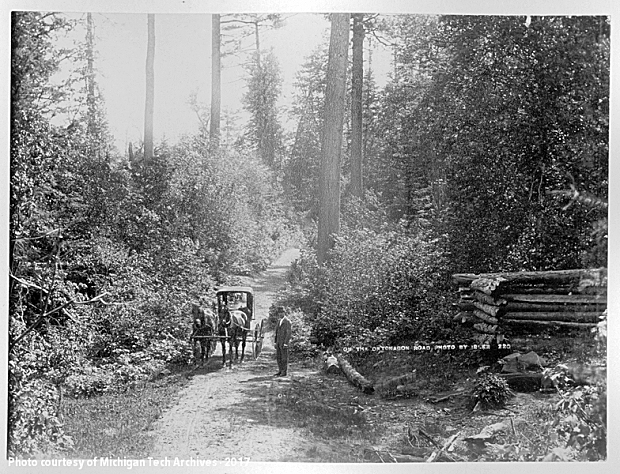
The description of this undated photograph from the MTU Archives states only that it was taken “on the Ontonagon Road.” While judging by the road surface, this was a very good road, devoid of stumps and large rocks, the photo illustrates the dense forest and underbrush with which road builders had to contend. It is unfortunate that there are no details describing the photograph; the log structure in the right is a curiosity.
Orrin W. Robinson, in the publication “Early Days of the Lake Superior Copper Country,” opined that the probable cause of the failure of the early Ontonagon mining attempts was the poor mining facilities and the high cost of transportation at the time. The time he referred to was the first decades of mining, 1845-1855.
“There were no roads from Ontonagon to any of the mines that was passable for loaded teams and all supplies were taken ten miles up the Ontonagon river, on scows poled by Indians, to the American Landing,” he wrote. “From there, they were teamed along the range to mines eighteen to twenty-five miles distant.”
That road, he wrote, was first graded in 1854, but it was so rough and muddy that good span of horses could not haul a load of more than 500 or 700 pounds over it.
Another likely cause of the failure of so many of the frontier mines is that in many instances, the investors who organized companies, and the men they sent into the wilderness to development, simply had no practical knowledge or experience in mining. One example of this is the Cushin, or Cushman, Location. The Cushin mine was opened in 1849, later became the Forest Mine, before becoming the Victoria. The Mines Register, Volume 2 (1901) states:
“The history of the Victoria up the time of the present organization is one of misdirected effort, mistaken financing, and poor judgment.” The Ontonagon Copper Company, which was organized to develop the property, gave it up within a year and was dissolved in 1853.
As Robinson had pointed out, distance and bad roads were also major contributing factors to early failures.
“The Victoria is located on a high and tremendously steep hill rising from the west bank of the Ontonagon,” the Mines Register reported.
Just getting supplies and equipment to the location was a challenge C.C. Cushman could not overcome. Even if he could find an inexpensive way to get goods and equipment to the top of the hill, he still had the additional problem so aptly pointed out in the Register:
“Notwithstanding the height of the hill, the surface of the rock formation is covered with a heavy drift of sand and clay, and this overburden renders explorations tedious and costly.”
While Cushman was struggling to open the Cushin Location, the Ontonagon Mining Company began clearing its site in the Greenland district. The developer of that tract, George C. Bates, experienced similar challenges to those experienced by Cushman, but Bates had some advantage over Cushman, at least as far as geography was concerned.
According to Knox K. Jamison, in his book, “A history of Rockland, Greenland Mass: and other towns in Rockland, Greenland, and Bohemia townships in Ontonagon County, Michigan,” when Samuel Knapp explored the Ontonagon company tract (1847), the Ontonagon company had several buildings and a warehouse on the banks of the Ontonagon River.
“Transportation was of necessity by boat up the Ontonagon River from the mouth, about 12 miles to the unloading points,” Jamison wrote. “A few crude wagon roads were built east of the river to service the mining location located two miles away.”
At the location, Bates, who was director and also agent of the mine, had managed to sink two shallow shafts just south of the present town of Rockland. That the company failed is probably largely due, not only to its remote location, but because Bates was a Detroit lawyer and not a geologist or mining man. More bluntly, he simply did not know what he was doing. In 1847, Samuel Knapp explored the same property and discovered prehistoric mining pits. Two years later, the tract became the Minesota Mining Company, the second largest producer of native copper behind the Cliff Mine.
The Piscataqua Mining Company, organized on March 27, 1848, and like the Ontonagon company, quickly failed. On Oct. 10, 1850, the Bohemian Mining Company was organized when its investment group purchased the failed Piscataqua property.
“On the 21st of January (1851), I took charge of the Mining Department of the Bohemian Mines,” wrote mining captain Henry Bawden in a letter to the company directors. “At the time little had been done in the way of mining, further than clearing off the surface of the vein, and clearing out some Indian works”
The Charter and By-laws of the Piscataqua Mining Company of Michigan, includes a report, dated Nov. 20, 1850, which states:
“The improvements consist of Dwelling-House, Black-Smith Shop, and Store-House & etc. A road has been opened on the Ontonagon river, and all necessary work is in a state of forwardness. A force of fifteen hands was at work on the 6th of September, which has probably been considerably increased.”
A letter to the president of the Piscataqua Co. dated Sept. 6, 1850, written by the mine’s superintendent, Charles Whittlesey, described the “Dwelling-House” as 18 by 24 feet, with two additions, 18 by 24 feet.
A couple of weeks earlier, on Aug. 16, Whittlesey had penned a letter to the president, in which he sent a list of supplies needed for 13 hands for eight months. Based on this, Whittlesey was submitting an order for supplies for the winter, before the winter closed the shipping season.
Whittlesey, among the most respected geologists in the nation at the time, wrote: “In conclusion, let me assure you that nothing on the Ontonagon, for the work done, looks any better than the Piscataqua; and I think, if appearances are not deceitful, we shall next summer need stamps to prepare our work for market, and we shall have plenty to keep them busy.”
Whittlesey, in a May 28, 1851 letter to the company treasurer, came right to the point of one of the main contributions to early mine failures, in spite of a promising copper vein:
“I should like very well to see operations pushed,” he wrote, “but until we can get some kind of good road to get out supplies, we shall labor under excessive disadvantages. Every thing brought out now, has to be brought out on the backs of horses. Our hay and horse feed has been brought from Detroit. A plank road from here to the falls of the Ontonagon, some eight miles, would set us upon our feet at once, and until this is completed, we must rely chiefly upon the winter to get out our supplies.”
On June 12, Superintendent Joseph Coulter wrote: “It is very important that the Company should come to some definite conclusion about a road at an early period.”
In the end, the company wasted more money on not constructing a road than it would have spent to build one. Before the company gave up, it had expended on the location $182,000, of which $13,300 came from the sale of copper, the rest by sales of stocks and assessments.