
Trending
I was asked the other day by a friend, "How do we keep our goodness and grace amidst what is going on?" I thought of a historical time not unlike our own. Enter the world of the 1700's. We often call this the Revolutionary Era, and it is similar to what we are undergoing currently in our global world. With our new technology changing the way we communicate, global immigration and the development of commercialism and consumerism have led to a disconnect between our human person and the challenges of a diverse society. All of these elements seem to swirl around us in our waking hours today.
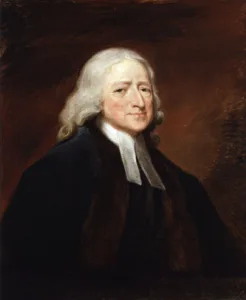
God never leaves us; He is actively at work in the hearts of those willing to follow Him. One of the individuals who comes to mind when looking at our current problems is John Wesley (1703-1791). John’s father was a minister in the Anglican church. John decided to follow in his father’s footsteps. He entered Oxford University to begin his education for the ministry.
John’s world was full of problems not unlike our own. The temper of the time was really about the race for markets and colonies, but also about new ideas about government and individual rights. These surfaced not only in England but also in France. We may also add here that the colonies in America held by the British Crown were involved. The very concept of government was being challenged, as were economic growth and wealth creation. These were not shared by the majority, but the influence of these rational ideas would ultimately shape the society they would live in. John Wesley lived during these horrendous times; remember, the American Revolution was 1776, and the French Revolution was 1789. The world was changing.
What did John do so memorably in Church history? John was conservative by nature and was taken by the lack of Christian values he saw all around him. The Anglican Church, or, as we call it in the United States, the Episcopal Church, had grown into an institution that was cold and disconnected from many people. The church was associated with the government, as it was supported by the crown. The Church had become ineffective and rigid; this kept emotional, real-life experiences out of worship. Wesley was drawn to preaching and to recognizing real problems people faced. He did not isolate emotions but saw them as manifestations of God working with us in this life. He also met the people where they were, preaching to them in fields, traveling to them wherever they were gathered. He read extensively in books on Faith and Religion, regardless of which denomination wrote them. The book that had a great impact on his understanding of
Christianity, after the Bible, was Thomas A. Kempis’s Imitation of Christ; this book, even today, is the most widely read next to the Bible. It was here in his early career that he had an ethical conversion. To quote John, "These books convinced me more than ever of the absolute impossibility of being half a Christian."
His practical balance of emotion and spirit, as well as a quest for holiness in everyday living, caused many to follow him. His method was fairly simple, and engaged every member, not just a few. He wanted weekly communion, holy living, discipline, and pious study. His members fed the hungry, freed debtors from prison, and performed numerous acts of charity in their community. This impacted the moral behavior of the times. Perhaps the most significant connection here was their stand on slavery. They set a new moral standard on this issue. It was this high moral standard that motivated the founding of the Anti-slavery movement. (Wesley influenced William Wilberforce, (1759-1833). Wilberforce was politically influential in abolishing the Atlantic slave trade. The Wesleys also sang; it was John's brother, Charles Wesley (1707-1788). He wrote Hark! The Herald Angels Sing' as well as some 8000 hymns, many still used in worship in churches today. This surge of religious fervor, called the Great Awakening, in America, where itinerant preachers and camp meetings, both ideals from Methodism, had a great moral influence on the young American nation.
Why would I spend this much time writing about John Wesley? Because God never leaves His people. He asks entrance into hearts, and when the soul sees and accepts God's call, great things happen. Christianity has many heroes and saints who have been faithful to the path Jesus calls us to. We as Christan's living in these turbulent times have wonderful examples of how to live in these trying and confusing days. God never leaves us; He does not promise a path free of problems, but He gives us the grace and help of His concern and love. Each and every person reading this today only has to make themselves attend to His presence through prayer, kindness to others, and concern for the community. Don't be, as John Wesley said, a half Christian. Amen
Psalm 69:9 "It is zeal for your house that has consumed me."