
Betty Chavis: MTU employee transformed university
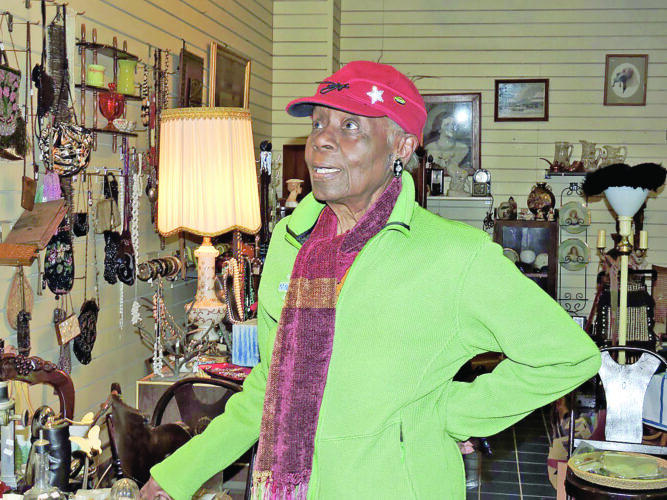
Graham Jaehnig/Daily Mining Gazette
Betty Chavis spent a career improving the lives of minority students, not only at Michigan Tech, but throughout the country. She currently enjoys owning and operating her antiques and collectibles shop in the Copper Country Mall, Betty’s CAAT.
HOUGHTON — In 1989, while Betty Chavis was working in the state Legislative office as the administrative assistant to Sen. Basil Brown, Michigan Technological University’s President Dale Stein contacted Chavis with a request to come to the university to work on a team to diversify and grow the student population at Tech. She did that — and far more.
In her 25 years at Michigan Tech, Chavis worked with several campus student groups and, as she said, has sat on every one of the university’s committees. She developed Black History Week to spotlight accomplishments of Black Americans in the United States. She has been the adviser to the Michigan Tech African Student Organization, and she also initiated Women’s History Week to highlight issues of importance to women at Michigan Tech and elsewhere.
Chavis and a colleague, Mary Ann Brunner, organized and launched the Parade of Nations, an annual event celebrating some 80 nations represented by Michigan Tech students. The Parade of Nations is just that: a parade through Houghton and Hancock, followed by a food festival held at the Dee Stadium in Houghton. The parade, in which participants wear attire specific to their national culture, and the festival, which comprises cultural foods from those nations, exposes the local population to a colorful glimpse of world cultural anthropology.
As former director of Outreach and Multi-Ethnic Programs at Tech, Chavis developed programs that meet and address the diversity needs of the university and the local communities. She has recruited minority undergraduate and graduate students through high school visits, presentations, conferences and networking.
She has received the Keweenaw Peninsula Spark Plug Award; the Blue Key’s Clair M. Donovan Award, as well as the Michigan Tech Employee Excellence Award. She was selected to participate in the Summer Institute for Women in Higher Education Administration at Bryn Mawr College.
Along with her several awards recognizing her accomplishments, Chavis was honored at the Michigan Tech Alumni Association Awards in August 2009. The transcript of the program preserves an honor that colleagues and friends of Chavis established in recognition of her many contributions to Michigan Tech: the Betty Chavis Emergency Fund.
“Since arriving on campus in 1989, Betty worked tirelessly to develop programs to meet the diversity needs of the university and the local communities,” the transcript says. “Many alumni can point to Betty as their champion.”
The fund was established to provide support for students who are experiencing a financial emergency due to unforeseen circumstances.
Thanks to Chavis’ efforts, a whole generation of “Betty’s recruits” made their way to the Western U.P. This group of students, with encouragement and assistance from Chavis and her colleagues in the Educational Opportunity Department at Michigan Tech, made Tech their own. In 1989 when Chavis started at Michigan Tech, there already existed a Black Student Association. This organization was soon joined by the Society of Intellectual Sisters, the Society of African-American Men and the National Society of Black Engineers chapter (NSBE), all founded by the students.
Chavis, a Detroit native, graduated from Cass Technical High School in 1977 which, until that year, was Detroit’s only magnet school, and the only non-neighborhood enrollment school in Detroit, and was, and is, selective. Cass provides students opportunities for Advanced Placement coursework and exams.
After graduating from Cass Tech, Chavis attended Wayne State University, graduating with a Bachelor of Arts in Communication. She also studied dance.
She auditioned for the Katherine Dunham Dance Company and was offered a placement in an experimental group that allowed her to travel extensively. The first African-American Modern Dance company was a touring troupe of dancers, singers, actors and musicians.
Subsequently, she formed her own troupe.
“After coming back to the city, I had a dance group, the Ognimalf Dancers,” Chavis said. “It started with Phil Giles, who was one of the biggest black entrepreneurs in the Idlewild, Michigan, area, which was a location for Blacks that were educated, elitist people. He had a night club there, and our group started there. So, Ognimalf spelled backward is Flamingo, and that was the name of the club.”
Chavis said when Stein invited her to Houghton for her interview, she had had no thought that she would spend the next quarter-century working for diversity and inclusion. At that time, her legislative office position focused primarily on senior citizens, visiting senior facilities around the state and filing reports.
When she first came to Houghton, she said, she arrived in a fur coat and high heels in a snowstorm, with “snow up to your ‘gazoo.'” When she got off the plane, her first thought was: “Oh, h*** no!”
Initially, she declined Stein’s offer, but a month later, she said, “they sweetened the pot.” Additionally, she added with a laugh, she was in a relationship she was trying to end, and Houghton was the best place she could think of to go to get out of it.
Chavis’ accomplishments, achievements and her own personal history, could fill an entire book. But, what do the awards mean to her?
“Nothing can be more ingratiating than to hear words,” she said. “Awards and all that don’t mean anything. But when you hear appreciation from a person’s mouth with all sincerity, that means more than anything in the world.”