
A fitting memorial
Propeller honors Lake Linden man
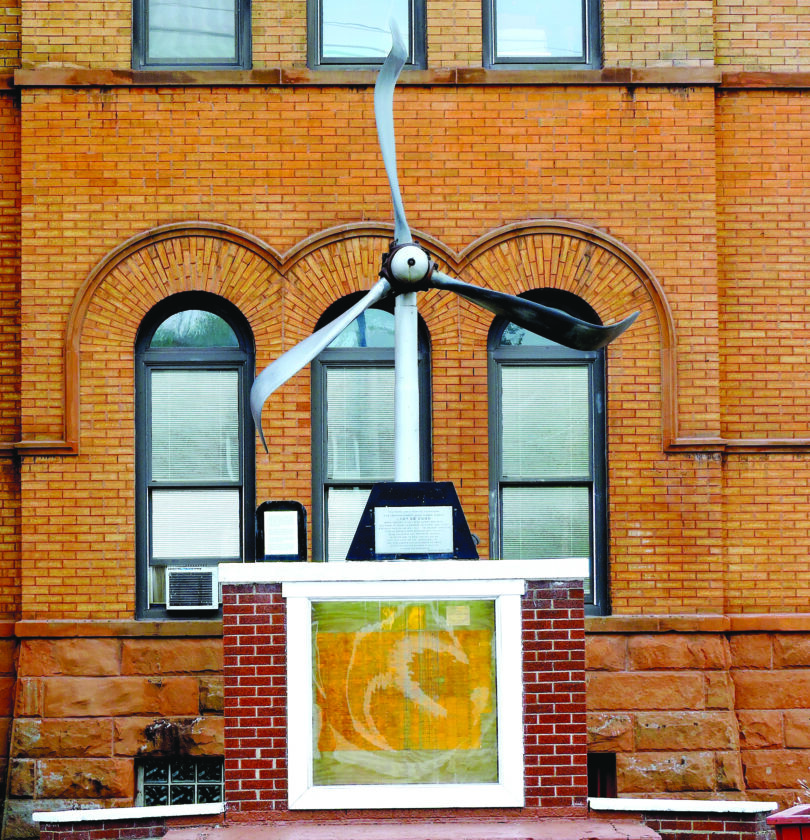
Graham Jaehnig/Daily Mining Gazette A propeller from the B-24 Liberator heavy bomber, Lady Be Good, marks the honor roll of the village Lake Linden, and stands as a memorial to one of its lost crewmen, Lake Linden native Robert E. La Motte.
LAKE LINDEN — They had come from across the United States; from Whitestone, New York, North Attelboro, Massachusetts, Kansas City, Missouri, Cleveland, Ohio, New Boston, Ohio, New Cumberland, Pennsylvania, from Saginaw and Lake Linden. They were nine men who comprised the crew of a B-24 Liberator heavy bomber they named “Lady Be Good.”
Lady Be Good was part of the 514th Squadron of the 376th Heavy Bombardment Group, 9th U.S. Army Air Corps. The 376th began combat missions using B-24 aircraft. The unit flew from bases in the Middle East from Nov. 1942 to Sept. 1943, then flew missions with Twelfth Air Force during the next year.
The Lady Be Good was a new plane that spring, having reached the 376th on Mar. 25, 1943. The American Air Museum in London states it was one of 25 B-24s assigned to bomb Naples late in the afternoon of April 4,1943. The crew took off from Soluch Field on its first mission shortly after 3 p.m. High winds and obscured visibility prevented it from joining the main formation of bombers. It continued the mission on its own. Their mission was the second part of a two-part, two-flight raid on the Italian harbor of Naples, with two flights of 13 B-24s.
Nine B-24s returned to base almost immediately after takeoff because of a sandstorm, the Air Museum in London, reports, and four aircraft, including, Lady Be Good, continued on. They arrived over Naples at 7:50 pm. at 25,000 feet. With bad visibility, they did not bomb the primary target, but two B-24s hit their secondary target on the return trip, and two dumped their bombs into the Mediterranean to reduce weight and save fuel. Lady Be Good became lost and attempted to fly back alone from Italy on the return trip to Benina, its home base in Benghazi, Libya. It was the only aircraft missing from the bombing mission from Soluch. It was not seen again for 15 years.
The wrecked plane was sighted from the air by an oil exploration crew in November 1958, and the bodies of eight of the crew were found in 1960. Most of the plane was still intact, with the equipment inside perfectly preserved and much of it still functioning. The plane was in such good shape because when the crew jumped, only one engine was running due to the plane being out of fuel, making the plane glide gracefully down as it slid on landing.
Upon investigation of the wreckage and the surrounding desert, the remains of eight crew members were recovered and identified by U.S. Military records, in 1960. Among the crewmen recovered was Lake Linden native Technical Sergeant Robert E. La Motte, the plane’s radio operator.
The remains of the eight crewmen were returned to the United States, including La Motte, who was buried in the Lake Linden cemetery.
The crew became lost on the return flight and overflew their home base. They continued south into the darkness of the desert night. Eventually, the bomber began to run out of fuel. When two of the four engines stopped, the nine men bailed out into the darkness.
According to the American Air Museum in London, after parachuting to the desert floor, eight of the nine airmen had managed to meet up by firing their revolvers and signal flares into the air. They had been unable to find the ninth crewman, bombardier Lt. John Woravka, because, unknown to them, his parachute had only partially opened and he likely died on impact.
A diary found on one of the crewmen revealed what happened. Thinking they were fairly close to the Mediterranean coast, the eight surviving crew members walked north, leaving behind footwear, parachute scraps, Mae West vests, and other items as markers to show searchers what their path had been.
They survived for eight days, sharing only a single canteen of water while walking over 100 miles in searing heat before perishing. Remains of five airmen were found in a group nearly 80 miles from the crash site. The other three, Guy Shelley, “Rip” Ripslinger, and Vernon Moore, had set off seeking help while the other five waited behind. The bodies of Shelley and Ripslinger were found 20 miles and 27 miles further north, respectively. Moore’s remains were never found, although it is possible that in 1953 his body had been spotted and buried by a British desert patrol, unaware that any air crews from the war had ever gone missing in the area.
In 1968, while on an inspection tour with U.S. Dept. of Defense, Lake Linden resident Octave DuTemple saw a propeller from the Lady Be Good at Wheelus Air Force Base, in Libya. DuTemple initiated the request for the propeller to be sent to Lake Linden as a memorial to all veterans and their families. The propeller was eventually shipped to Lake Linden, where today it resides outside Lake Linden Village Hall.