F1 Review: Wrapping up 2025
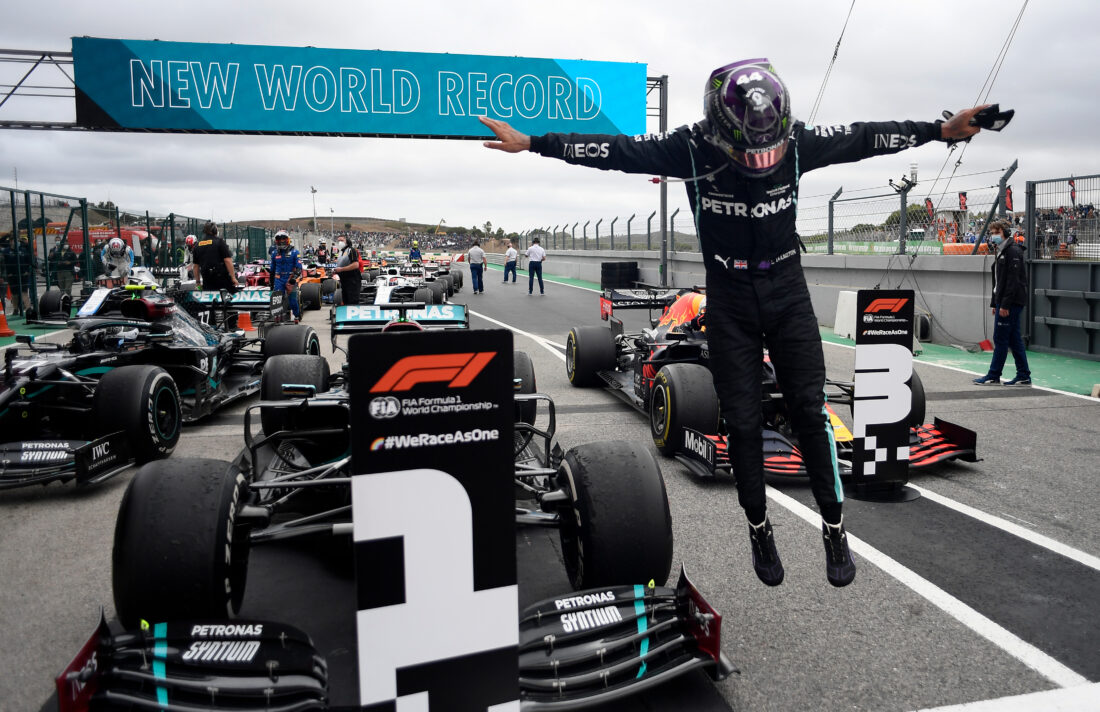
FILE - Mercedes driver Lewis Hamilton of Britain jumps out of his car after his record breaking 92nd win at the Formula One Portuguese Grand Prix at the Algarve International Circuit in Portimao, Portugal, Sunday, Oct. 25, 2020. (Jorge Guerrero, Pool via AP, File)
Back in February, I made my case for 2025 being a year to watch Formula 1 (F1) racing, whether you have never seen a race, had gone away from it in the past, watch it casually, or even if you’re already an ardent fan of the sport. Now that the season has concluded, I wanted to look back and see if those were promises fulfilled, or if I’d missed the mark.
In the same order I made them, here are the arguments and this season’s outcome related to them:
1. I suggested that the fact seven different drivers won at least two races each in 2024, 2025 would be even more exciting. That didn’t quite live up to the hype as there were just four race winners over the 24 races. George Russell drove his Mercedes to victory twice, McLaren teammates Lando Norris and Oscar Piastri each accounted for seven wins, and former world champion Max Verstappen managed to rally his Red Bull team to eight wins. While we didn’t get a prolific number of race winners, what was still true to my prediction was that we never quite knew who would be on pole position and who would win the race. For the most part, there was a decent 1 in 3 chance of guessing right though.
2. Similar to my first point, the closeness of the Constructor’s Championship in 2024 between McLaren, Red Bull, Ferrari, and Mercedes made me think 2025 would provide much the same. Instead, McLaren cruised to a championship by the end of the Singapore Grand Prix which was race number 18 of 24. McLaren ended the season with 833 points. If you add up the points for Ferrari, in fourth, through Alpine bringing up the rear in tenth, they scored a combined total of 887 points.
Part of McLaren’s dominance was having a great car which allowed both their drivers to compete for the championship. The only other team that had both drivers regularly scoring was second place Mercedes where Russell nabbed 319 points and rookie Andrea Kimi Antonelli impressively scored 150 points. For Red Bull, Verstappen scored 421 of the team’s 451 point total. Ferrari struggled all season, particularly in the hands of Lewis Hamilton who only scored 156 points (though, to be fair, Charles Leclerc in the other Ferrari only managed 242).
There was still plenty of action in the Constructor’s Championship with second place going down to the final race between Mercedes and Red Bull, and sixth through ninth place spread out by only 22 points. Coincidentally, 22 points is what last place Alpine scored, the highest total for the last place team in F1 history. Considering a driver gets 25 points for one race win, I don’t know Alpine is too reassured by that fact.
3. Close finishes aren’t the most common result in F1 racing throughout the sport’s history, but 2024 ratcheted things up. This is one area where my prediction rang true for 2025 living up to and actually surpassing what 2024 gave us. Australia, the season opener, had 0.0895 seconds between Norris in first and Verstappen in second. In Japan, it was 1.1423 seconds between first and second with just 0.706 seconds between second and third. The two McLaren drivers were separated by just 0.698 seconds in Hungary, and the top three were separated by 3.233 seconds in the Netherlands. There were certainly still dominant performances at the lead of the race, but it was more uncommon than common to have the full 10 points paying positions determined before the end of any F1 race this season, a welcome change overall.
4. Seeing the United States represented with two separate teams in F1 for 2026 was my final reason to watch the sport in 2025. While that might sound a bit backwards, it still makes sense to me because it allowed a groundwork to be laid down for expectations next season. Haas is the American team that has been around the longest, started back in 2014. Cadillac will be on the grid in 2026 and we finally know who will be driving for them: seasoned veterans Valtteri Bottas and Sergio Perez. Many were disappointed they didn’t choose any American drivers, but the pickings are frankly slim when you look to the F1 feeder series. Picking two drivers who have won before and have something to prove made a lot of sense and gives them a decent chance to perform well even in their first season.
Back to Haas, they did pretty well in 2025. They managed eighth place, out of ten teams, and were only 10 points behind seventh place, and a further three points behind sixth. Rookie driver Oliver Bearman excelled at qualifying and managed to score points in 10 of the 24 races including an impressive fourth place in Mexico. Hopefully the team can capitalize on their success in 2025 to continue doing well in 2026.
Too many things remain unknown for Cadillac’s entry into the sport. The combination of rule changes all the teams are facing next season means no one knows where any team will be. However, those wanting to go all in on cheering for Americans in F1 can look to the feeder series for some extra excitement. Colton Herta, now a former Indy Car driver, is the test driver for Cadillac’s F1 team and will be racing in the F2 series next year. Another American, Ugo Ugochukwu, was exciting to watch in F3 in 2025 and he’ll return to the series in 2026, upgrading to a better team. He came close to some race wins last year and looks to have a good shot in the future.
I ended my article on the final F1 race saying no one should be disappointed in the 2025 season for F1, even the fans. Looking back on my pre-season predictions, I may not have been all that accurate in selling what the sport actually gave us, but it did provide quite a lot of excitement with the driver’s championship going to the very last race of the season. As I mentioned in my pre-season article, the only thing predictable about F1 is just how unpredictable it can be.
National Sports

U.S. and Canadian women eager to renew their fierce hockey rivalry at Milan Cortina Games

Patriots’ Maye had pain-relieving injection in shoulder before 3 turnovers in Super Bowl loss
Seahawks ride their ‘Dark Side’ defense to a Super Bowl title, pounding the Patriots 29-13

Lindsey Vonn breaks leg in downhill crash at Winter Olympics, in stable condition at hospital

Ilia Malinin’s stunning free skate secures US figure skating team gold at Milan Cortina Olympics