
F1 Review: Blue flag fiasco
Trending
HUNGARY -- As Formula 1 (F1) teams completed the second race of a back-to-back series in Belgium and Hungary, they are now on a mandatory summer break. This comes at an opportune time as temperatures and tempers were both running high in Hungary.
Perhaps the driver most aggrieved, and rightfully so, was McLaren's Oscar Piastri. Here is a rundown of how his race weekend went. For starters, Piastri didn't drive in the first practice session because Leo Fornaroli, a development driver, was in the McLaren instead. Each team is required to put "rookie" drivers in during four practice sessions throughout the season, and this weekend was planned for Piastri to sit one out.
This was of particular importance because the first practice session is the time to get everything figured out with regards to how this season's new cars will perform at this particular track. Given the immense overhaul of the cars, every practice session has a renewed importance this year.
As the second practice session got underway, Piastri was back in his car, but with the old car and not the updated model the team brought to the racetrack. The rationale here was that the team could get a side-by-side comparison between Lando Norris' updated McLaren and Piastri in the older model to make sure the updates were an improvement.
Saturday morning, in the third practice session, Piastri finally got on track with the updated car and could try to settle in to how the updates work and how the new car would handle around the track. This is also a good time to mention all drivers were having difficulties out on track including: dirt blowing across the driving line in the high winds, the winds themselves being unpredictable from corner to corner, the cars having trouble with the bumps on track, and the resurfaced areas not "gripping up" as expected meaning the cars had a lack of traction in the final corner.
In short, Piastri was on the back foot going into qualifying. Given that Norris was one of the favorites for pole position, this was unfortunate for Piastri as the updated McLarens seemed like they were true competition for the Mercedes cars, the team that had a monopoly on pole positions so far this season.
Piastri managed to qualify fifth, but thought he could've achieved a little more if he wasn't blocked by Ferrari driver Lewis Hamilton in the session. Hamilton, who qualified in second, knew a penalty was coming for blocking Piastri, and dropped three places. Championship leader Kimi Antonelli qualified his Mercedes in fourth, but was also given a three-place grid drop for failing to slow down sufficiently in a yellow flag area. These penalties promoted Piastri up to third position for the start of the race behind Ferrari driver Charles Leclerc in second, and Norris on pole.
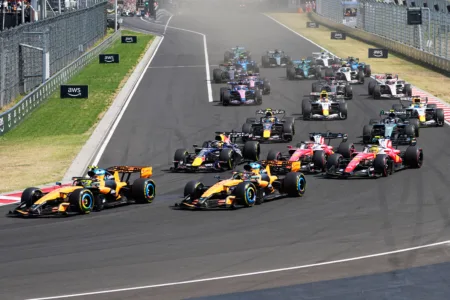
As the race got underway, Piastri shot forward and managed to steal the lead from his teammate after Norris went wide in a corner. Keeping up a good pace, the two McLarens extended a pretty sizable lead over third place Max Verstappen who managed to get his Red Bull past Leclerc and stay ahead of a charging Hamilton.
Norris was on the radio complaining to his team that he was "miles faster" than Piastri, but the team didn't give any team orders to change positions. Piastri had the lead fairly and they were extending their lead, so all was well.
On lap 13, Hamilton came into the pit and got off his soft tires which were degrading quickly. His pace on the fresh hard tires was quick, so Red Bull responded by bringing Verstappen in on the next lap to keep him ahead of Hamilton. Their pace forced McLaren to react as well, pitting Piastri from his medium tires that could've probably done more laps, and he barely made it out ahead of the charging Verstappen and Hamilton.
Norris was called in the next lap as well, and he squeezed into position behind Piastri and ahead of Verstappen, and all four of the drivers were stuck behind Verstappen's teammate Isack Hadjar who was still on his older tires. Eventually, the whole group passed by Hadjar and the gaps spread out once more between the top four drivers, Piastri still in the lead.
On the radio once again, Norris said he was faster and wanted to do a strategy different to Piastri to make something happen. Meanwhile, Antonelli pitted on lap 22 and had a blinding pace compared to those who stopped earlier. McLaren was now a little nervous about their lead.
Piastri was brought into the pits on lap 33, three laps after Hamilton made his second stop from fourth place. Perhaps Hamilton's accelerated pace forced the reaction from McLaren as Piastri was struggling on his hard tires, or maybe they wanted to give Norris some clear track to see if he could prove he had a faster pace. Regardless, the decision left Piastri mired in traffic, trying to pass some of the back markers who were having a fight of their own.
Fernando Alonso in his updated Aston Martin was ahead of Carlos Sainz's Williams, and they were fighting over 16th position at the time. Piastri, who was in 4th position and lapping the other two cars, should've been given priority to pass even though the other two drivers are fighting over position in their own right.
In F1, there are flags that tell the drivers what is going on. Most commonly known are yellow flags, meaning there is a dangerous situation ahead, green flags for clear racing, and the chequered flag for the race finish. There are also blue flags to let drivers know that a faster car in a higher position is coming up to lap them and they need to yield.
As technology has progressed, so has the flag system. It used to simply be human marshals around the course who would wave flags from strategically located positions. Then, digital displays were put around the track to show the flags instead. Now, there are even LED lights that display on driver's steering wheels to let them know what flag is out, even for blue flags using GPS locations for the cars.
In Hungary, that system was on the fritz. Haas driver Oliver Bearman noted, "At the start of the race, I was getting blue flags after six laps, and I thought, 'Wow, that’s strange. We’re not that slow to be lapped in six laps.' So from lap six basically until lap 70, there were some blue flags every single lap, so it was really tough to know what was real, what was fake, what was for me, what wasn’t, because normally you have your number, this time it was just the blue."
The steering wheel system was disabled and the digital displays weren't working like normal which did confuse drivers. However, track marshals were still waving blue flags at specific cars. There are backwards facing mirrors on the cars as well, so drivers should've visually been checking for the faster cars and their race engineers should've been on the radio to help with driver awareness.
Back to Piastri who was closing in on Alonso and Sainz. Sainz was pushed to the outside by Alonso who was defending his position, and then Sainz cut back across the track trying to get inside for the next corner. The problem was, that was exactly where Piastri had placed his car to get by the dueling pair.
Fortunately for both drivers, it was tire to tire contact meaning neither had a broken car. The collision did bump Piastri onto the dirt and he almost lost control of his car. Even though there wasn't a cataclysmic outcome, that didn't make the situation any more acceptable as Sainz influenced the outcome of a race when he was already a lap down on the leader and impeded a driver fighting for that lead.
Norris did manage to show he had a faster pace than Piastri, but since Piastri had new tires on his car, he was still driving at a net gain compared to his teammate. He most likely would've been out ahead of Norris if everything went well. Given the difficulties in traffic and nearly being taken out by Sainz, Piastri lost his chance to maintain his lead and Norris retained it after his second pit stop.
Piastri was furious with Sainz, mad at his team for pitting him when he would come out in traffic, and lamenting the lost lead. On lap 56, Piastri was even mad at his car as his gear box broke and he retired from the race while in third place.
Though this ended up as another race to forget for Piastri in what has been a lackluster season thus far, Norris went on to show that, given reliability, the McLaren cars can win races this year. Verstappen managed to luck his way into second place after driving the last 29 laps of the race on soft tires. Antonelli had a swing of fortune finishing ahead of his championship rivals, closing out the podium in third place.
Many questions lingered after the race, starting with McLaren's decision to pit Piastri when they did. Ferrari had questionable decisions throughout the weekend. Their pace looked strong and they were considered favorites for the race win. Both cars started on soft tires, forcing them into earlier pit stops. Neither car could get past Verstappen, and Ferrari fell further behind in the driver championship.
The looming question though is what the FIA will do to avoid future blue flag fiascos. While Piastri's adventure is highlighted here, there were a host of scenarios, and several penalties, for driver's not yielding position. Technological advancements are great, but when they malfunction, there needs to be another way to maintain racing standards. Given that drivers were able to do so before the technology, both the drivers and the teams are really at fault for the embarrassingly poor job they did in Hungary.
There is plenty of time to figure things out as all teams now have a four-week break. Racing resumes on Sunday, Aug. 23, when the teams race through the exciting banked Netherlands course starting at 9 a.m. Eastern Time.