
Trending
LANSING -- Michigan's unemployment rate increased faster than the national average over the past year, while many rural counties in the state are experiencing deepening economic distress, according to a Labor Day report released Monday by the Michigan League for Public Policy.
The report, "A Snapshot of Michigan's Workforce," determined that Michigan had the fourth-highest unemployment rate in the nation at 5.3% as of June 2025, compared to the national average of 4.1%.
Meanwhile, more than half of Michigan's counties -- 54 out of 83 -- reported unemployment rates of 6% or higher, with rural communities hit the hardest.
"This Labor Day, as we honor our state's deep roots in the labor movement and the significant contributions of Michigan's workers, it's important to take a close look at the current health of our workforce and what we can be doing to better support the people who make up the backbone of our economy," Monique Stanton, president and CEO of the Michigan League for Public Policy, said in a press release.
The report also found that workers' real earnings are being eroded as wage growth in Michigan is being outpaced by rising costs, with 27% of Michiganders reported to be employed, but under the classification of "asset-limited and income-constrained," otherwise referred to as ALICE.
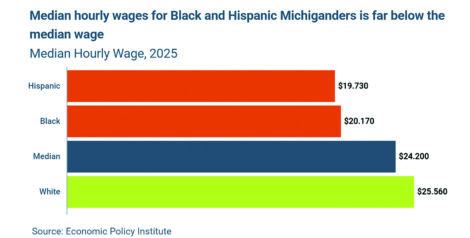
Persistent wage disparities remain for Black and Hispanic workers, as well as for women, particularly women of color, who continue to earn significantly less than their white male counterparts.
"The median wage for Black workers in the state remains significantly lower than white workers, sitting at $20.17, which is 21.6% lower than the median wage of white workers," the report said. "It is no surprise that as a result, 42% of Black Michiganders find themselves below the ALICE threshold." The report notes that the income gap is even slightly larger for Hispanic Michiganders, with median wages about 23% lower than that of white workers.
The report links declining union membership and what it terms as "state-level anti-worker policies" to stagnant wages and reduced protections for employees. As a result, it calls for a reversal of laws such as Public Act 98 of 2011, which limits the ability for builder trade unions to negotiate terms of employment, and Public Act 105 of 2015, which limits local governmental bodies from regulating employment terms.
The league says taken together, the pair of laws have weakened labor protections and hindered local governments' ability to promote fair labor standards. The league's recommendations to strengthen Michigan's economy and support its workforce include:
•I ncreasing the minimum wage to a living wage and eliminating the sub-minimum tipped wage
• Investing in public transit and K-12 education, and reducing the cost of post-secondary training and college
• Expanding access to affordable child care through increased scholarship reimbursements for providers, which could also help address the ongoing shortage of child
care workers
• Making construction and skilled trades jobs more attractive by repealing laws that limit collective bargaining and labor standards
"While there is an overall job shortage in Michigan, there are some sectors of the state's workforce where workers are urgently needed. This includes the child care and construction workforce," Stanton said. "If we want Michigan to be a state where working families can raise young children and support the growing demand for newly built homes, we need to be making the jobs in those industries more desirable for prospective candidates."
Stanton said that improving compensation and working conditions in these sectors, which she says are often dominated by women and people of color, is essential to building a more equitable and resilient state economy.