
Trending
HOUGHTON -- What is oak wilt? Oak wilt is a deadly forest disease caused by an invasive fungus (Bretziella fagacearum) that attacks healthy oak trees of any size. It is particularly fatal for red oaks, which is cause for alarm in the Keweenaw, where red oaks are the only oak we have.
On its own, oak wilt can spread short distances through the roots of infected trees, however, there are other elements at play. Native sap beetles find themselves attracted to tree wounds in the spring and summer, and can pick up oak wilt spores when visiting infected trees. The beetles can then spread oak wilt as they move to other wounded trees in search of sap. This means any freshly pruned or storm damaged oak trees are at risk of being infected. Oaks need our help to protect them from oak wilt.
Cause for alarm?
Oaks are one of the most well known and foundational trees in the western hemisphere. They are a keystone species, and especially valuable to creatures that use acorns as a major source of nutrition. Additionally, oak trees host over 450 species of butterfly and moth caterpillars, which supply food to over 96 percent of songbirds. English poet Ann Hawkshaw describes the oak tree as "the monarch of the wood," which is a fitting title for a tree that typically grows so large and strong over such a long time.
In addition to their ecological and aesthetic properties, oak trees play a valuable role in our forests and economy. Local oak wilt expert and Michigan Technological University professor, Tara L. Bal said "we have a significant amount of oak forest in our area, especially northern red oak and northern pin oaks which are vulnerable to the disease. Current value estimates of oak timber alone in the state are over a billion dollars." Dr. Bal also mentions the social value of oaks, as they are commonly planted in urban areas and yards. This issue may hit close to home for our community.
Oak wilt in Marquette County
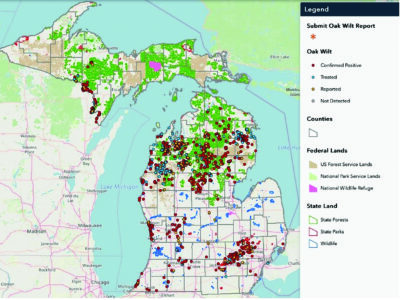
Oak wilt was recently found in Marquette County about 25 miles from where it had previously been confirmed. Bal explains, "oak wilt has been present in the UP for decades along the Wisconsin border in Menominee, Dickinson, and Iron County." The newly discovered patches in Marquette County are notable because of their location far from the closest known previous infection. The sudden appearance rather than gradual spread of oak wilt suggests that humans may have played a role in this jump.
Bal says the movement of contaminated firewood could have led to the spread of oak wilt. "We may not ever know exactly how it was spread or introduced to Marquette County, but this is a reminder that oak wilt can still move around our landscape and we should be aware of it."
Two ways to prevent the spread of Oak Wilt
• Don’t move firewood.
Forest pests often spread through the movement of firewood. In addition to the beetles that carry oak wilt, firewood can also carry emerald ash borers, hemlock wooly adelgid, and other invasive insects and diseases. Here are some firewood tips from the State of Michigan:
"Buy it where you burn it." Firewood is available for purchase at many campgrounds or may be collected on site. Purchase certified firewood. If it has been heat-treated to USDA standards, it will bear a USDA or state-based certification stamp with the producer's name and address.
As a general rule of thumb, firewood should not be transported more than 10 miles from where it came from.
• Avoid pruning oak trees between April-October
Bal advises "if you do need to harvest or prune, avoid doing so in Michigan during the strict no-pruning time from April 15-July 15. Late fall and winter is the lowest risk time of year," because the sap beetles that carry the fungus are unlikely to be active during the winter months. November is a great time of year to prune oak trees that need attention.
Report suspected oak wilt
It is important to know the signs of oak wilt so that you can report it. Common symptoms include early and rapid leaf loss. Suspect oaks should be reported to the DNR or to the Midwest Invasive Species Information Network (MISIN).
For additional information about oak wilt identification and reporting head to www.michigan.gov/invasives/id-report/disease/oak-wilt.
the don't move firewood campaign or to learn more about firewood laws and quarantines in Michigan head to www.michigan.gov/invasives/laws/dont-move-firewood.
This article was written by Paul Branstedt, Lauren Hemmeke, August Camp, and Sigrid Resh of the Keweenaw Invasive Species Management Area