
Family of deceased Tech student files lawsuit
Lawyer: 'They killed him'
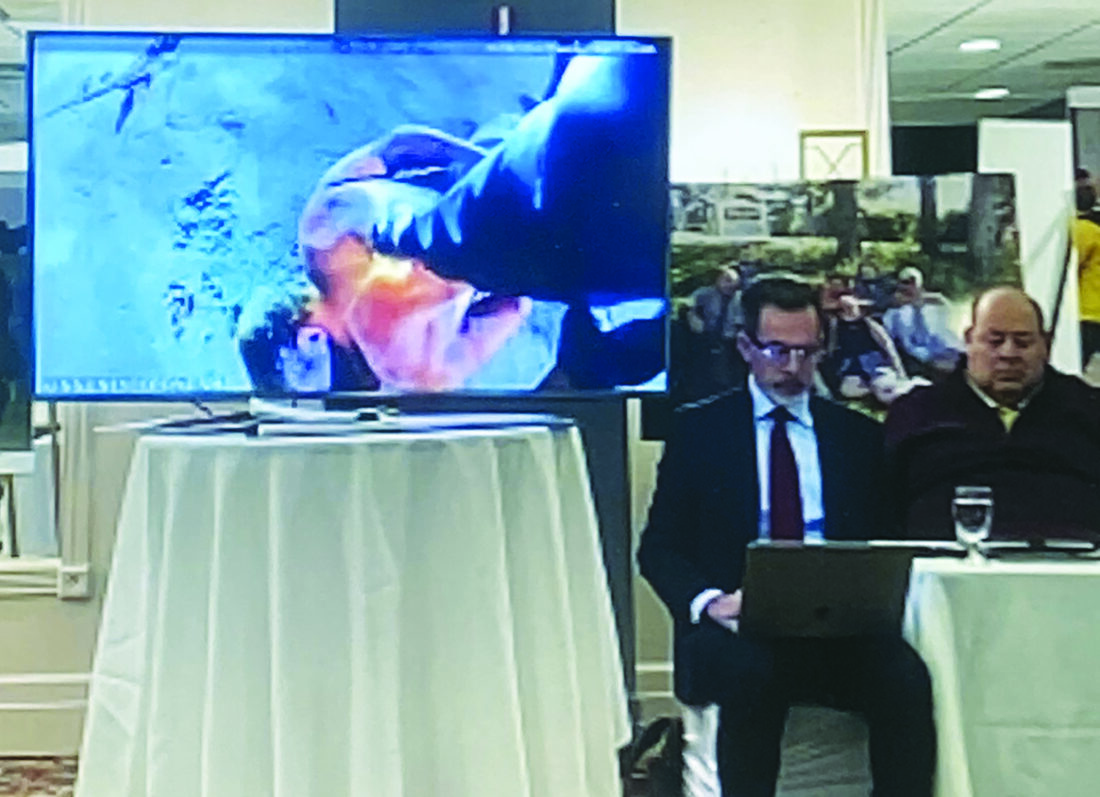
This photo via Zoom screen capture was taken during a press conference in Marquette. At the conference a video was played showing police attempting to arrest Ben Walby in the early morning hours of March 23, 2024 outside of his apartment in Hancock.
MARQUETTE — The estate of a Michigan Tech student who died after an incident involving local police nearly two years ago has filed a lawsuit in Federal Court. The suit, filed Monday in U.S. District Court in Marquette by the estate of Benjamin Walby, names the cities of Houghton and Hancock, Houghton County, and 11 law enforcement officers. In addition to the three municipalities, the suit, filed by attorneys James Harrington and Gary Felty of the Southfield, Mich., firm of Fieger Law, names law enforcement officers Scott Weubben, Alan Jurmu, Nathan Kinnunen, Dylan Grentz, Peter DeKryger, Bradon Knoop, Sgt. Jeremy Hill, Brock Poyhonen, Haley Bianucci, Jennifer Hastreiter, and Blake Frantti. The officers named were from several different law enforcement agencies.
A press conference was held Tuesday morning at a Marquette hotel attended by Harrington, Felty, Walby’s family, and Marquette media. The press conference was also conducted via Zoom and attended by media from throughout the state, including the Daily Mining Gazette. Felty explained the purpose of the press conference and of the lawsuit itself. “We’re here to express the truth of what happened in the death of Ben Walby,” Felty said. He explained that news reports of the incident, which occurred in March of 2024, are different from the truth. “The press said he died from self-inflicted wounds. Our investigation is very disturbing and very different from that story.”
“This is about civil rights, it’s about an American who was killed by police,” he said. Felty claimed that Walby was “hog-tied” by police, a practice he described as illegal, and tasered numerous times. “Ben died from a combination of being tasered and a lack of oxygen to the brain. He was brain-dead and lived for 14 days on a ventilator.”
According to the suit, the incident occurred in the early morning hours of March 23, 2024, outside Walby’s Hancock apartment. Police received a phone call from a neighbor reporting “banging and incoherent yelling” coming from an upstairs apartment. Initially, four officers from three different departments responded to the noise complaint. The lawsuit states, “The officers did not have any reason to believe that Benjamin Walby, whose identity was yet unknown to them, had committed a crime or posed any danger to them or others.”
At the press conference, Felty said, “This should have been a routine response to a mental health incident.” He said the plaintiffs are critical of the training given to the officers and critical of their response. “They chose violence,” Felty said, adding, “Civil rights don’t disappear in mental health cases.”
The 22-year-old Walby was a Dean’s List student at Tech majoring in software engineering. According to the lawsuit, he was preparing to graduate with a bachelor’s degree at the time of his death.
Felty played a video obtained from police body cameras of the incident. While at first four officers responded, soon there were 11 on the scene. While blurry at times, the video showed police attempting to subdue Walby. The video also showed medical personnel at UP Health System Portage performing CPR to revive him.
After the video was played, Fieger Law Managing Partner James Harrington took to the podium. “In that video we saw excessive force,” Harrington said. “We saw him hog-tied while being tasered. He needed to be put in a position of recovery, but not a single person helped.” Harrington said Walby was not put in the vehicle in a position of recovery and that officers missed every opportunity to save the man. “They killed him,” Harrington said. “The officers killed him.”
In concluding the press conference, Harrington said, “Why are we here? We’re here for answers, we’re here for truth, we’re here for justice.” The suit is seeking financial compensation in excess of $75,000 from each of the defendants.