Speakers discuss grants, ideas for improving recycling
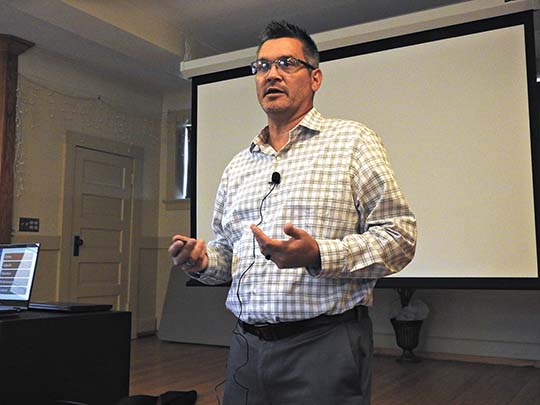
Garrett Neese/Daily Mining Gazette Brad Austin, executive director at the Marquette County Waste Management Authority, discusses the county’s single-stream recycling facility during a talk at the Carnegie Museum Thursday.
HOUGHTON — Local leaders learned more about recycling efforts at the state and regional level Thursday.
Tracy Purrenhage of the Department of Environment, Great Lakes and Energy (EGLE) and Brad Austin of the Marquette County Waste Management Authority spoke at the Carnegie Museum of the Keweenaw.
EGLE is trying to support communities with recycling grants and other programs to help raise Michigan’s recycling rate from 18% to 45%, said Purrenhage, an EGLE recycling specialist for the Upper Peninsula and northern Michigan. The national rate is around 34%.
Reaching 45% will help create jobs in the state and spur economic development, Purrenhage said.
“We want to implement recycling programs where they don’t exist, and then expand and grow and improve recycling programs where they do, that need that extra boost,” she said.
EGLE wants to improve the quality of recyclable materials, which will result in better end products, she said. Another priority is finding more markets for recycled materials in-state so the material doesn’t have to leave Michigan.
A focus of EGLE’s grants is infrastructure, such as recycling containers, carts and site improvements. In 2019, the state introduced the Renew Michigan Fund, which provides $15 million annually for materials management, including planning, infrastructure and market development.
EGLE closed its current round of recycling infrastructure grants in August, and is making recommendations to its division director. Communities provide a minimum 20% match in funding. The next request for proposals is hoped to be out by the end of the year, Purrenhage said. Recently, EGLE released an RFP for grants to grow markets for recycling in Michigan, which will probably have two or three rounds of applications, Purrenhage said.
A new round of education and outreach grants will be geared specifically to communities with fewer than 10,000 households. The state has also launched NextCycle Michigan, an idea incubator in areas like organic waste reduction and using recycled materials in roads. Eighty-six entities are participating, including Michigan Technological University and Marquette County’s Recycle 906 facility.
“At the end of that, we’re hoping that there’s going to be some funding for different groups depending on how they get through those tracks,” Purrenhage said. “Some of those groups might be ready for funding before, but it really is to flesh out ideas that groups have that aren’t quite shovel-ready projects.”
The state is also launching professional recycling training, which will include grant-writing, best practices for curbside and dropoff recycling and other areas to help communities gain expertise. That should be available sometime in 2022, Purrenhage said.
Austin is executive director at the Marquette County Waste Management Authority, which launched single-stream recycling at the Recycle 906 facility in Marquette County last year. Since the start of the year, the facility has grown from Marquette County only to nine counties across the U.P. and Wisconsin. Material from Houghton County’s recycling winds up there, which many people don’t realize, Austin said.
“The facility was built to process every piece of recyclable that will be produced in the entire Upper Peninsula,” he said.
It has diverted about 8,500 tons from the landfill this year — short of its capacity of 12,000 to 14,000.
The authority also launched a website, recycle906.com, which includes a search function allowing people to enter a product and find out the best way to dispose of it.
About 1,000 tons per year are coming from Houghton County — about 500 tons short of the lowest-performing standard for single-stream based on the number of households, Austin said.
“The focus and the effort should be getting people to recycle more, and recycle better,” he said. “There’s already curbside programs in the area, so if we’re going to put energy somewhere, let’s get the numbers up, let’s get the participation up in the current system that we have.”
Austin welcomed the addition of the single-stream recycling bin at the Houghton County Transfer Station, which had diverted more than 12.5 tons between May and October.
The Marquette County facility uses means such as ballistic separators and artificial-intelligence robots to separate materials and distinguish between specific resins of plastic.
Marquette County also accepts glass, which is separated out at the municipal level. Having a clean feedstock for glass allows the facility to do bigger aggregate and sand products, such as a project with Michigan Tech involving Dickinson County roads.
“If we want to make products like this, then we need a clean feedstock,” he said. “And it is a little bit of an uphill battle because it is outside the normal. But we see some real results here more locally.”
Asked for ideas on involving commercial and industrial recyclers, Austin suggested engaging business owners with events such as a Business After Hours night.
He and Purrenhage also discussed ways that an area such as downtown Houghton could efficiently collect recycling. Some places have set up common dumpsters for recycling, Purrenhage said. Other places in the Lower Peninsula have used larger carts.
“It can be carts, it can be shared dumpsters,” she said. “Because you have the facility that will accept single-stream, that’s pulling in your haulers … everybody needs to play a part in making sure this works.”
Demonstrating results can help build support locally for funding to improve services, Austin said. He pointed to a survey showing 60% of Marquette County residents would support a recycling millage. Other options, such as Public Act 69 agreements, include household fees for recycling.
“Whatever it is that your vision is, just make sure it’s realistic and achievable,” Purrenhage said. “It doesn’t mean that you can’t have the dream program, but make sure it’s taken in steps, and understand what your success is … we don’t know if we’ve reached our goals unless we’re measuring what those are.”
Front Page

Man charged in Eastern UP crash
Calling out to contractors
HOUGHTON – The Houghton County Jail Committee’s Industry Day is Wednesday, July 15, at the Franklin Township ...
Staying away
Calling out to contractors
Isle Royale closes campground again