Several options available for county wastewater plant
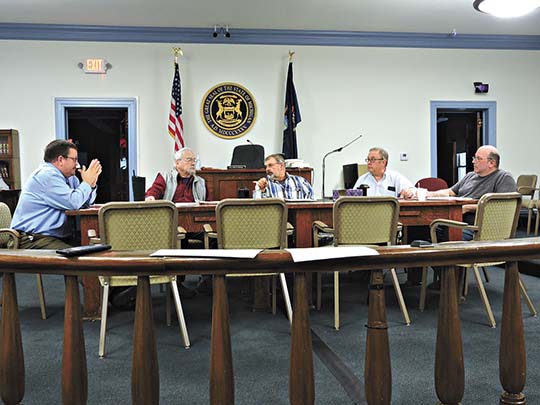
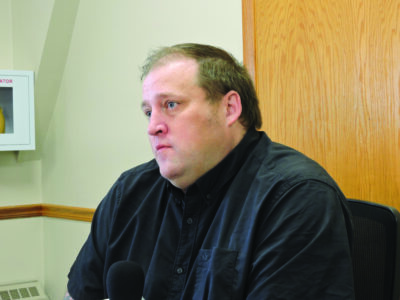
Graham Jaehnig/Daily Mining Gazette Keweenaw County Board members (left to right) Del Rajala, Jim Vivian, Board Chairman Don Piche, Bob DeMarois and Randy Eckland, discussed several options for the county-owned wastewater treatment facility at Mt. Horace Greeley at the April regular meeting. Among actions taken, the board will explore the costs of having valves replaced.
EAGLE RIVER — The sewage lagoons at Mt. Horace Greeley were the focus of some discussion at the regular meeting of the Keweenaw County Board of Commissioners on April 20. Zach Garner, of Open Skies, the group that purchased the former Calumet Radar Base on Mount Horace Greeley, addressed the board and informed them of the poor condition in which the sewage lagoons are.
Commissioner Del Rajala asked Garner if the county decommissioned the lagoons, would Open Skies be interested in receiving them. Garner said that his organization is not in a position currently to assume the expense involved. However, at some point down the road, he said Open Skies may be in a position to assist the county with re-lining or decommissioning the system, but currently, the group is not in a situation to do that.
Board Chairman Don Piche said that the quotes he received on decommissioning the lagoons ranged from $50,000 to over $1 million.
Rajala commented on the span of the quotes, saying it was quite an unbelievable span.
Piche said that if the contents of the lagoons are safe to discharge after being tested, it would be cheaper to do that, but if not, Environment, Great Lakes, and Energy (EGLE — formerly the Department of Environmental Equality) wants the liners removed, which is the reason for the high cost of the estimates.
While the board would rather leave sewage treatment up to the townships, Piche said the system at Mt. Horace Greeley is a benefit to the taxpayers of the county.
“Let the township take it over,” Rajala suggested. “We don’t need to be in the pond (sewage treatment plant) business.”
Garner informed the board that several of the valves between lagoons one and two have failed and need to be replaced very soon. He said he has made inquiries into the probable costs of replacing the failed valves as an initial step into bringing the lagoons back into compliance.
“That would at least allow us to get through the next few years without having to decommission the lagoons — unless there is a massive, catastrophic runoff failure, which would be super unlikely, given how little that they’re actually used.”
The estimates he obtained range between $40-100,000, he said, the lower estimate being based on if just the valves in one of the manholes need to be replaced, up to $100,000 if all the valves for the entire lagoon need to be replaced, plus some pipework and engineering.
“That’s only at a maximum scale for four years of revenue for the lagoons,” said Garner, “which is not a lot of money when you put it in that perspective.”
Garner said he believes it would be worth making at least that investment in the meantime, then seeing what funding will become available, if any, to deal with the liners down the road.
Although they are few, there is the possibility of a couple of grants, including one at the state level, he said, but they will undoubtedly be matching grants, and hopefully the county would have that revenue set aside by the time they may become available.
Piche said that one of his points of concern in the county not keeping the system operational is the county residents use the facility, including Allouez Township, which has a contract with the county, and there is also a possibility that Houghton or Calumet Township could refuse the sewage currently handled by the county’s treatment plant. When the Grant Township treatment plant failed a few years back, he said, Calumet would only receive a percentage of the content of that plant. Garner said the Calumet Township plant is aging as well.
Commissioner Bob DeMarois said all of the treatment plants are, because they were all installed around the same time.
Piche said one of the benefits to keeping the plant is that it would be cheaper to haul sewage to that plant than to haul it elsewhere.
Tom Wierciak, treatment plant operator for both the plant at Mt. Horace Greeley and for Grant Township, told the board that from his personal standpoint, the Mt. Horace Greeley plant is county property and has not been managed well.
“Right now, it’s just sitting there,” he said. “Yep, the septic haulers are hauling there; you guys are making in the Thirty grand a year (range), but that’s it. There’s been nothing going on. There’s been no maintenance on the thing or anything like that, so we’re in a bad spot.”
Wierciak said that while the county is not doing anything, the wastewater inflow and outflow, and whether it is going to be repaired or decommissioned, there is still nothing going on.
“And if (Open Skies) is willing to step in and do the leg work for the county and bring this up to compliance,” he continued, “I see that as a win-win.”
The board agreed to explore options. A motion was made by Rajala, supported by Eckloff and unanimously carried, to get a better idea on a price to decommission the lagoons, to obtain a request for proposal (RFP) for replacing the valves, and Commissioner JimVivian will reach out to a local contractor to see about the price that he was given a couple of years ago on used valves.
The board also unanimously approved a motion to create a separate account for the revenue generated by the treatment plant so that the money can be applied to its maintenance.