
Citizen help wanted
Hancock seeking aid with zoning ordinance
Trending
HANCOCK - Hancock will look to get citizens involved in determining changes to the city's new zoning ordinance.
Planning Commission Chair Kurt Rickard said at Monday's meeting he intends to form a subcommittee including citizen members to prepare recommendations for the planning commission.
"That's the best way for us at the planning commission to work to make changes - get three of us and community input, come up with some recommendations, get the whole planning commission to agree with it," he said.
The planning commission would then move those recommendations to the city council, which would have final approval. Suggested changes to the language would probably be bundled into an amendment to the zoning ordinance, Rickard said.
Earlier this month, the city council approved the new zoning ordinance, the city's first large-scale change to its zoning in 50 years. At its most recent meeting, the council directed the planning commission to discuss possible amendments to the ordinance based on feedback from residents dissatisfied with the ordinance.
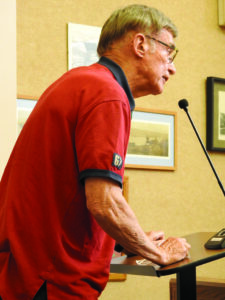
About 15 people attended Monday's meeting, many of whom had recommended changes. The bulk of the comments were concentrated on the new Shoreline Mixed-Use district and the concerns over businesses being opened near Sylvan Estates.
The Shoreline Mixed-Use district came out of a recommended future use in the city's 2018 master plan. It combines areas along the waterfront that had previously been multiple-family residential, industrial and conservancy. That was done in part because of the "unique physical, biological, economic and social attributes" of the waterfront, the ordinance said. The city's desired development pattern in the district is commercial and residential development along with recreational uses on a neighborhood scale.
Requirements for zoning permits in the district include a vegetative buffer zone.
Residents said parts of that district should be more clearly marked to not allow commercial development. Stephen Roblee suggested a residential zoning from the Carmody-Lahti property on Navy Street to Forest Street.
"I don't think people really want to see all of the activities that are listed as possible activities in the SMU, at least not everywhere," he said.
Jennifer Becker said while zoning the waterfront for residential use would be an improvement over the SMU district, she preferred to see it be as accessible as possible for residents and tourists. She also hoped to see it become easier for people to reach the waterfront: living in east Hancock, it can take her as much as 15 minutes to cross the highway to go running, she said.
"Obviously in the past, it's not really been developed in a cohesive way, but I think that pockets that are dedicated to recreation and conservation will draw people down, and those should be incorporated in addition to R-1 (single-family residential)," she said.
Another discussion topic was Sylvan Estates, where an Open Space and Recreation district around three sides of the district creates a 150-foot buffer from B-1 (local business district) along Campus Drive, which includes land previously zoned residential.
Amber Anderson, who lives in Sylvan Estates, said her family had been considering building an addition on their house, but have postponed it in light of the rezoning.
"One of the reasons we decided to purchase was a family-friendly feel, and having a business district surrounding that neighborhood is contrary to that," she said.
Resident Boone Fiala said eventually connecting Birch Street to Campus Drive might have the benefit of redirecting fast-driving high-school students away from the roads near the subdivision, while potentially keeping business far enough away to not interfere with quality of life.
"I think how they’re going through that neighborhood like I did in high school, how fast we drove," he said.
Rickard said the rezoning was done to promote growth in the city.
"The plan is to create neighborhoods where you have the services that you need, you don’t have to drive in your car and drive forever to get the services," he said.