Calumet CopperBots show off at open house
Team had U.P.-record finish at world championships meet, in top 1% worldwide
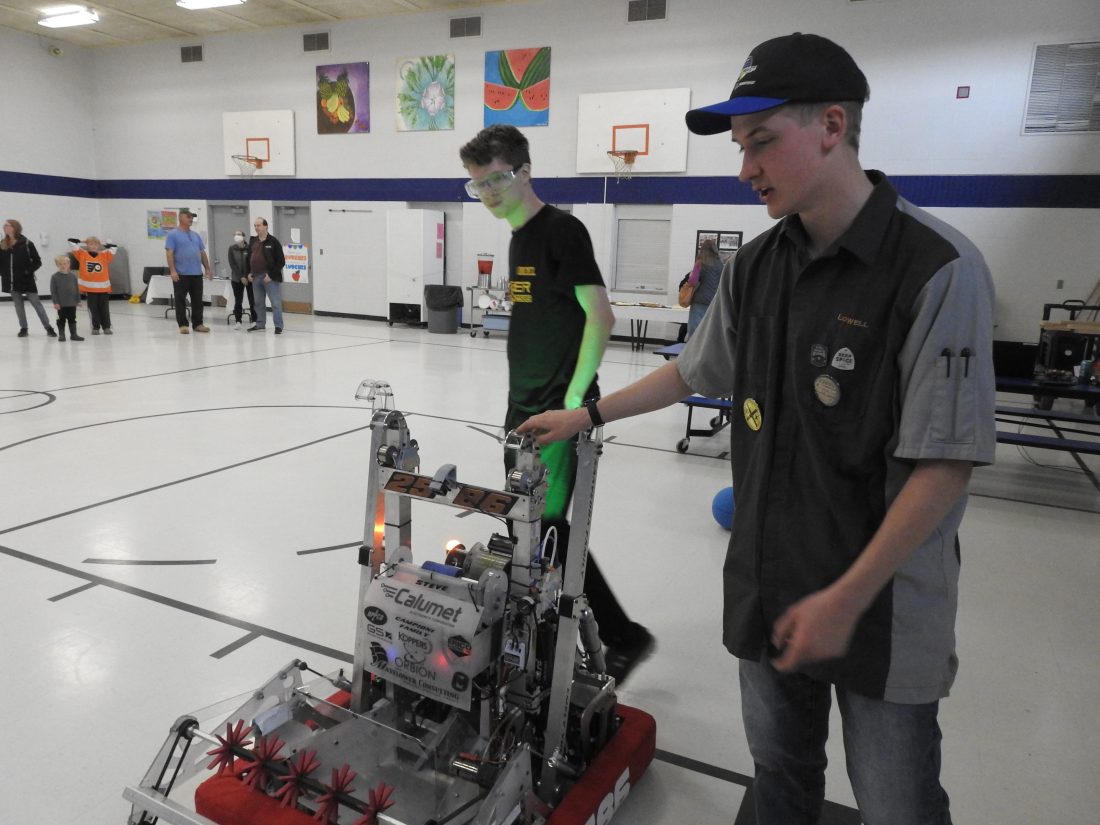
Garrett Neese/Daily Mining Gazette Calumet CopperBots members Braden Miller, left, and Lowell Torola explain the workings of their robot during an open house Thursday.
CALUMET — Ranger whirred to life.
Spinning, the robot then pivoted toward 8-inch balls on the floor, taking them up before coming to a stop and launching them toward an 8-foot-high hoop several feet away.
The shots Ranger launched Thursday night were just a fraction of those it had shot during countless trials leading to increasingly prestigious competitions this year. The team that designed, built and refined it, the Calumet CopperBots, was on hand to display Ranger and the process that went into it during an open house at Calumet High School Thursday.
The CopperBots recently competed at the World Championships in Houston, where they reached the semifinals, placing ninth in their division. That final ranking, which placed them in the top 1% of teams worldwide, was the best showing yet for an Upper Peninsula team.
The team is part of FIRST Robotics, a high school competition in which students build robots to complete a field game while forming alliances and competing against other teams.
After last year, when events were held remotely, competing with 15,000 screaming fans was a rush, team members said.
“We’re standing right next to each other when we’re operating,” said 11th-grader Braden Smith, who drives the robot with team captain Lowell Torola. “I’m yelling at him because you can’t hear. There’s announcing, people screaming.”
The task changes every year. This season, teams had to build a robot to pick up the 8-inch balls of the color assigned to their team and shoot as many as possible into the 8-foot-high target during a two-minute period.
The robot must operate autonomously during the first 15 seconds of the match, during which time points count double. For the next 2.5 minutes, two drivers on the team pilot the robot with an Xbox controller.
The robot is also built with arms to accomplish its final task: climbing a set of monkey bars five feet in the air.
Other than core electronics, students can’t reuse anything from the previous year’s robot, Torola said.
“We design everything custom in computer-aided design, and we machine everything in-house ourselves,” he said. “It really just comes down to your imagination, and what you can design and create to accomplish the task.”
After designing the robot, the team works part by part to fabricate it, said team member Abraham Perala. For intake, the team made 3-D printed spacers to collect the balls, then went through several designs for the intake before settling on wheels to get the balls in. All told, they fabricated about 500 parts over the course of the season, generally taking about an hour or two to print.
“We go through a lot of testing,” he said. “It’s either until it breaks, or we have a better idea.”
What material they use for printing depends on the task. Nylon is strong, but not as accurate; it also tends to shrink, said 11th-grader Gabriel King-Takacs. For parts requiring more accuracy, they use PETG, a polyester that holds its shape and enables added accuracy.
With the inevitable turnover due to graduation, team members train their successors. Team member Charles Jackson taught King-Takacs the nuances of 3-D printing.
“I plan to buy a 3-D printer so I can continue this over the summer,” King-Takacs said.
With a small 10-person team, everyone does a bit of everything, Torola said. But some people gravitate toward particular interests, such as programming for Torola or mechanical design for Miller.
Keating Dinsmore came in with coding experience, but to fill a need, she moved to electronics and pneumatics. Electronics are generally the same for each season, but new developments come in, such as this year’s Limelight, a smart camera built specifically for FIRST Robotics. Pneumatics allow Dinsmore to regulate air pressure for different subsystems, such as the intake and the arm. A built-in switch prevents the system from going over 60 pounds per square inch, the maximum allowed.
The club has changed her life, said Dinsmore, who now plans to become an electrical engineer.
“Just learning from scratch all of this and how to make an actual machine, it’s changed my life in a huge way,” she said.
Even once the robot is built, the team has to be ready for anything that can go wrong. During the team’s first competition in Escanaba, the team had to strip Ranger to the frame after a complicated 3-D printed bearing assembly exploded. They fixed the problem right before the playoffs, and finished just short of the finals.
“Two points,” chipped in Miller, who didn’t need to look it up.
The team builds modularly with quick replacement in mind, like an arm and socket held in place with one bolt. And it means using polycarbonate in one high-contact spot instead of metal.
“Polycarbonate, you can beat the crap out of it and it’ll bend right back,” Miller said.
Opponents in the matches are randomly determined. During the playoffs, teams enlist others for alliances. To determine which teams would make a good match, teams need good scouting, said 11th-grader Ava Nagel. She showed sheets marking down other teams’ attributes in categories such as how much cargo their robot can pick up or how well they shoot at the high hold, which is the 8-foot target. That data is combined into an overall offense power rating.
Nagel said the biggest thing she’s gotten out of FIRST Robotics has been the experience of working with other team members. Between January and March, the team is working together every day after school, she said.
“When we’re arguing, and we’re not working together, then things start breaking and parts start coming out like junk,” she said. “Then, when we’re working well as a team again, it’s like, ‘Oh, that fits fine,’ ‘Oh, I put that there.’ So it was really nice to learn how everybody functions and everybody works together.”
Thursday’s open house was the second the team has held, bracketing two years where the team couldn’t hold one because of COVID. The team has also been active in outreach on platforms such as Facebook.
It has also gone out into the community. Besides Thursday’s open house, the team recently demonstrated its robot for the Copper Island Academy.
The CopperBots will display their robot at Bridgefest, and also practice with other teams at the U.P. State Fair.
“We’re putting it out there for people who want to see it, and hope they take advantage of it, because there’s a lot to share here,” coach Todd Waurio said.
Front Page

Judge strikes Trump immigration policy
Taking heat
Suspect arrested after Marquette shooting
Searching for answers
Editor’s note: The information in the following story, regarding the disappearance of Brett Parrett of ...
Family rescued on Keweenaw Bay
L'Anse — family of five from L’Anse was returned safely to shore Tuesday night after their 31-foot sailboat ...