
Not aligning with science
Wolf researcher responds to Bergman-backed bill
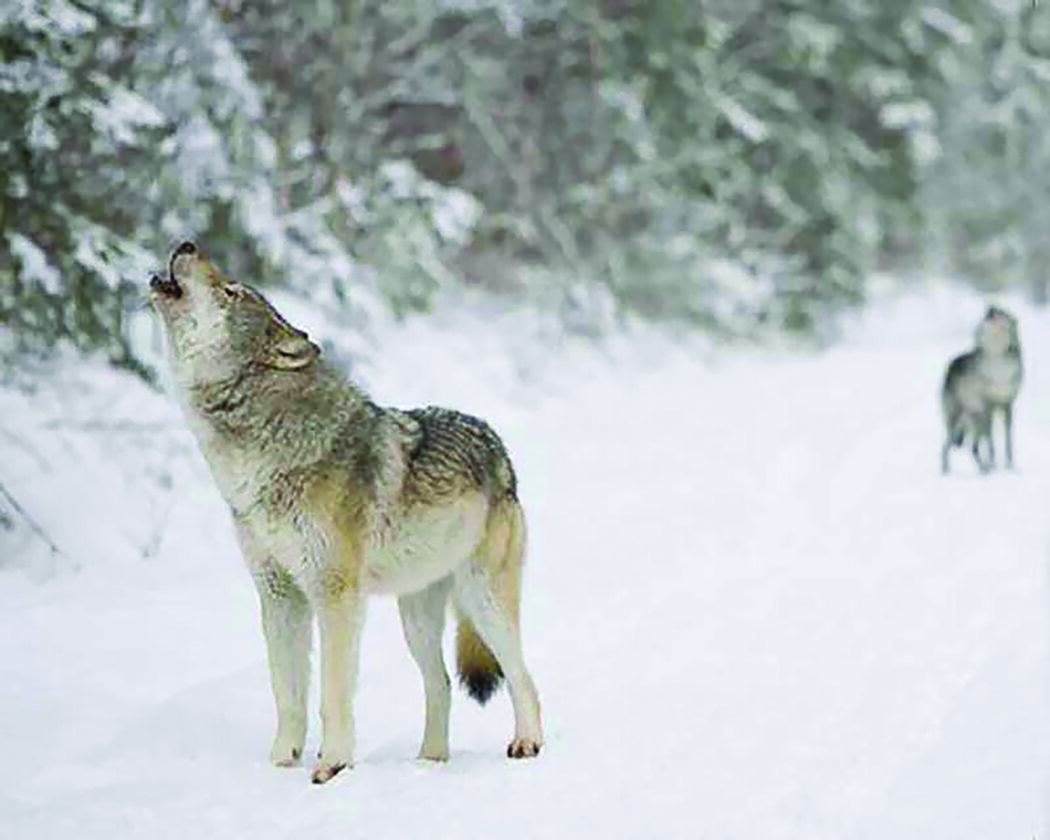
HOUGHTON – The U.S. House of Representatives passed a bill Thursday that would remove the gray wolf from federal endangered species protection across the country, and return decision-making on potential wolf hunts to the states. The legislation would also bar courts from reviewing the decision in an attempt to prevent animal rights and environmental groups from initiating legal challenges to ensure protections for wolves.
The “Pet and Livestock Protection Act” passed along party lines by a 211 – 204 vote. It will now head to the U.S. Senate.
Rep. Jack Bergman supports the bill, arguing it is science-based. A recent release from his office states, in part:
“Gray wolves have recovered far beyond the levels that originally warranted their listing. The science is clear – these populations are stable, self-sustaining, and thriving.”
The U.S. Fish and Wildlife Service also supports delisting the gray wolf. In a 2020 press release the USFWS said the vast majority of wolves in the lower 48 exist as two large, stable or growing populations totaling more than 6,000 individuals that are broadly distributed across the northern portions of three states in the Great Lakes area and all or portions of five states in the northern Rocky Mountains.
The population in Michigan, Wisconsin and Minnesota is about 4,200 strong, with the Northern Rocky
Mountains population in Montana, Idaho, Wyoming, Oregon, Washington, northern California and
most recently in northwest Colorado standing at around 1,900. Wolves have also begun to expand into western Oregon, western Washington, northern California and most recently in northwest Colorado.
John Vucetich, PhD, Forest Science, who is a wolf biologist with Michigan Technological University,
points out wolves are not as prolific in some regions as they are in others.
“The circumstance that we face is that in some places – Michigan may well be a good example – wolves are doing okay, but in many other places, they’re not,” Vucetich said, “so the law is currently written so that the species, generally speaking, is protected across the whole species range or not.”
On May 1, The Sun Time News reported wolves were nearly wiped out in Michigan by the mid-1900s. But after years of federal protection, they’ve made a remarkable comeback–especially in the Upper Peninsula. From the winter 2024 wolf population survey, 762 wolves now roam the U.P., a number that’s held steady for more than a decade.
While Bergman’s release asserts science shows gray wolf populations are thriving in each geographic region where they are located, they now occupy only a fraction of their historical range.
“The wolves used to occupy huge swaths of the lower 48 (states), and they currently occupy about 15% of what they used to occupy,” Vucetich said. “And so the question that’s pertinent runs something like this is: If I told you that there was a species that used to live in all of these places, and now they live in only 15% of the places that they used to, would you say that’s okay?”
Vucetich said Bergman is not invoking science accurately. “There’s nothing about the science that’s says wolves should be de-listed now,” he said. “There’s nothing about the science that says keeping them listed is any kind of an undue burden on Michiganders.”
Vucetich went on to say if Rep. Bergman wanted to explain more precisely what it meant about this rule of science, he would happily comment on it, but of course, he said, he is a scientist, a wolf biologist in particular, and the science does not align with Bergman’s claims.
Front Page

Not aligning with science
Jail scam
MARQUETTE — Mackinac County Sheriff Edward M. Wilk is warning residents of scammers who use the phone asking ...

Keweenaw County benefits from Operation Stonegarden

“Fitz” artifacts sold

Eagle Mine sold
