Expanding role
Law enforcement branches out
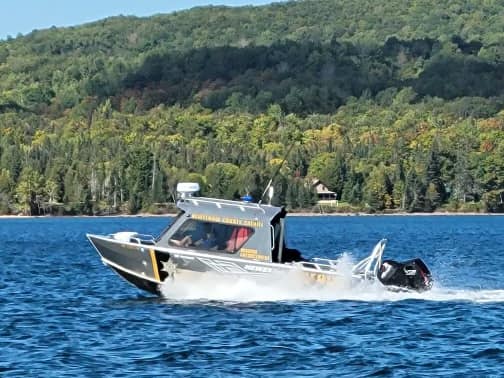
Keweenaw County Sheriff’s Office photo The role of law enforcement agencies has changed over the past 20 years and has expanded into medical first response, behavioral health response, search and rescue and water rescues of stranded boaters.
EAGLE RIVER — A resolution from Governor Gretchen Whitmer recognized yesterday (Jan. 9) as National Law Enforcement Appreciation Day. Her resolution states in part:
Law enforcement officers, including police officers, sheriff’s deputies, state troopers, federal agents, corrections officers, conservation officers, and motor carrier officers put their lives on the line every day to protect and serve the people of Michigan.
But, as Keweenaw County Sheriff Curt Pennala points out, over the past two decades, the role law enforcement agents fill has greatly expanded to now include frontline healthcare. “Law enforcement officers, wither it’s a criminal call, a mental health call or a medical call, are typically the first ones on the scene, and they start the communication process that plays a vital role in making sure we get the proper care headed to the scene in conducting triage process and transport to the hospital,” Pennala said.
Law enforcement officers are now trained to treat everything from mental health emergencies to head trauma to gunshot wounds.
Pennala said the Keweenaw County Sheriff’s Office holds the medical first responder license for the county, and oversees all other county-based medical first responder units..
“Our deputies are trained as medical first responders,” he said. “All law enforcement officers these days carry gunshot wound bandages, tourniquets, trauma care kits, and emergency equipment.”
Pennala said much of the expanding role law enforcement plays started with school shootings when officers became prepared to deal with mass casualty incidents and other emergencies.
When he entered law enforcement, officers were restricted to responding to criminal complaints only, said Pennala. “If a medical call came in, or a mental health call came in, those calls were not dispatched to us, because they weren’t law enforcement issues,” he said. “We dealt directly with car crashes, criminal conduct matters, suspicious situations and things of that nature.”
He said that over the past 20 years the role of law enforcement has expended to include any type of medical call.
Lt. Nick Roberts, with the Houghton City Police Dept. concurs. “A large portion of our job now is assisting people with behavioral health situations,” he said. “It’s everyday support we give people.”
Roberts said he’s proud to say he feels police officers are very well-trained to assist people with behaviorial needs and getting them the care they need, adding he is not just proud of his department, but all law enforcement departments.
“We’re definitely well trained,” he said, “and we do get more training, we get more training than ever.”
Officers are mandated by Michigan Commission on Law Enforcement Standards (MCOLES) to train each year.
“I don’t think people realize how much training we have to have,” Roberts said.
Hancock Police Chief Tami Sleeman agreed, saying law enforcement officers have taken on a new role.
“We definitely spend more time on those types of calls,” she said. “Our mental health calls are way up compared to years ago, which requires all the extra training that we need.”
Sleeman said she feels officers have become everything from social workers to first responders.
“I think that’s a good thing,” she said. “I think we’re the right people for the job, because of our training and the job we do.”
Front Page

It only takes a spark
When night falls

Expanding role

Notable books
Ice causes accident, road closure
IRON MOUNTAIN — At about the same time a bus carrying girls basketball players slid off the road in Marquette ...