
Cuts hamper invasive species efforts
Grant funding down $1.2M
Trending
MARQUETTE -- A $1.2 million decline in state grant funding to combat invasive species is challenging conservation organizations to rethink how they protect forests, waterways and communities.
Michigan awarded $2.4 million in grant funding for invasive species control in 2026, down from $3.6 million in previous years.
According to the grant program website, funding is set by the Legislature and the governor during the annual budget cycle.
The funding dropped because the state allocated less money in the 2026 budget, likely due to competing priorities and not because invasive species are less of a problem, said Joanne Foreman, the invasive species communications coordinator for the Department of Natural Resources.
The change came after requests for proposals had been released, which meant organizations applying for money had to adjust their priorities.
Foreman said the timing made the situation especially challenging.
"We had to make decisions then on the fly," Foreman said. "Applicants had already started developing applications."
In response to the decline, the state identified its top priority as maintaining support for Cooperative Invasive Species Management Areas, or CISMAs.
Michigan has 22 CISMAs that cover every county and help coordinate local responses to invasive species.
"We needed to keep our CISMAs whole because that's a really keystone part of the program," Foreman said.
Each CISMA receives $70,000 in base funding annually to support basic operations such as staffing and coordination, according to a press release from the Michigan Invasive Species Program, a joint project of the departments of Environment, Great Lakes and Energy, Agriculture and Rural Development, and Natural Resources.
Foreman said, "We told everybody that we would be prioritizing the cooperative invasive species management areas," leaving fewer dollars available for other proposals.
The shift also affects how the state approaches early detection, which is an important factor for stopping invasive species before they spread widely.
Foreman said reduced funding doesn't eliminate early detection efforts but changes how they're carried out.
"If we're scouting for one particular species, we ask people to scout for multiple species at the same time," Foreman said.
At the regional level, organizations are adjusting how they use their grants to maintain as much impact as possible in prevention and maintenance.
Shelby Bauer, the stewardship program coordinator for Huron Pines in the Northern Lower Peninsula said the Huron Heartland Invasive Species Network is focusing on a set of priority species this year.
"We have a top seven that we're going to actively manage this year," Bauer said.
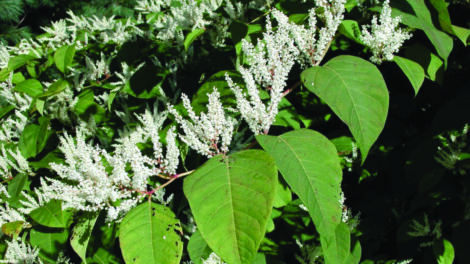
Those are garlic mustard, Japanese barberry, invasive phragmites, wild parsnip, Japanese knotweed, black swallow-wort and purple loosestrife.
Bauer said they were selected based on their presence in the region and ecological impact.
Funding is divided among prevention, early detection and direct control efforts. Prevention work focuses mainly on education and outreach, according to the press release.
"We are more focused on education," Bauer said, citing workshops, volunteer events and site visits where staff help landowners identify and manage invasives.
Huron Hartland also employs seasonal crews to carry out treatment work.
"We're going to have another team this year for both public and private land treatments on the ground," Bauer said.
To measure success, the organization tracks several metrics, including acres treated, number of workshops and attendance.
"The number of attendees is a big one," Bauer said. "It helps gauge whether outreach efforts are influencing behavior."
Bauer said consistent funding is critical because invasive species management requires long-term commitment.
"You can't really ever get rid of an invasive species just in one year," Bauer said.
In the Eastern Upper Peninsula, the Three Shores CISMA is using its base funding primarily to support operations.
Evan Chalmers, the program coordinator for invasive species at Three Shores CISMA, said most of its $70,000 allocation goes toward costs such as vehicle and work insurance.
That funding allows Three Shores to function, while additional grants from partners such as the U.S. Forest Service and the Great Lakes Restoration Initiative support specific projects.
However, Chalmers said the statewide funding cuts limits flexibility and shrinks the pool of money available for those projects.
"Everyone has to fight over a smaller pot," Chalmers said.
Chalmers said his team would like to conduct more extensive surveys on certain invasive species, such as reed mannagrass, but lacks the resources to do so.
"That's not an option this time," Chalmers said.
Despite the challenges, collaboration remains a key strategy. Organizations are working with federal and state agencies, municipalities, tribes, nonprofits and volunteers to stretch limited resources.
Public engagement is also playing a larger role, particularly in early detection, as residents are encouraged to report invasive species sightings directly to the CISMA in their county.
While long-term impacts remain uncertain, Foreman said the focus remains on protecting Michigan's ecosystems as effectively as possible with the resources available.
"Species that are recently introduced and can cause a lot of damage - that's primarily where we've been spending those grant funds," Foreman said.
While Michigan faces tighter budgets, both state officials and local partners say maintaining that consistency may become increasingly difficult, potentially leading to harmful species to gain more ground.