
Standoff escalates over Strait of Hormuz
Trump says talks to resume today
Trending
WASHINGTON, DC -- President Donald Trump said U.S. negotiators will be in Pakistan today for talks with Iran, resuming negotiations after Iran reversed its decision to reopen the Strait of Hormuz and warned that it would continue to block transit through the strait as long as the U.S. blockade of Iranian ports remained in effect.
The escalating standoff over the critical choke point threatened to deepen the energy crisis roiling the global economy and push the two countries toward renewed conflict, even as mediators expressed confidence that a new deal is within reach.
The strait is closed until the U.S. blockade is lifted, Iran's Revolutionary Guard navy said Saturday night. Hours earlier, two gunboats from Iran's Revolutionary Guard opened fire on a tanker transiting the Strait of Hormuz, the British military's United Kingdom Maritime Trade Operations center said. It reported that the tanker and crew were safe, without identifying the vessel or its destination.
Roughly one-fifth of the world's oil passes through the strait and supply constraints are driving prices higher once again. Meanwhile, a 10-day truce between Israel and the Iran-backed Hezbollah militant group in Lebanon appeared to be holding.
The fighting in the Middle East conflict, now approaching the two-month mark, has killed at least 3,000 people in Iran, nearly 2,300 in Lebanon, 23 civilians and 15 soldiers in Israel, and more than a dozen in Gulf Arab states. Thirteen U.S. service members have also been killed.
What's happening with ships in the Persian Gulf
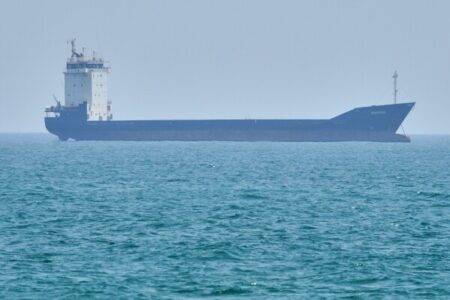
Vessels trying to transit the Strait of Hormuz have reversed course, according to the MarineTraffic shipping tracker. The Iranian navy has reimposed tight restrictions on transit through the strait while the U.S. blockades Iran's ports and waters. The standoff has left hundreds of vessels waiting in both directions for clearance through the waterway where a fifth of the world's oil supplies normally passes.
Kpler, a maritime data firm, said 19 vessels had passed through the strait on Friday after Iran and the U.S. announced the reopening of the strait late last week as part of understanding between the two governments.
But on Saturday, U.S. Central Command said it had sent 23 ships back to Iran since its blockade began, and at least three vessels were attacked by Iran Saturday while attempting to cross the strait, bringing shipping to a standstill again and further straining the global energy market.
US energy secretary Chris Wright says talks with Iranians over Strait of Hormuz are going well and the United States "is not too far away from a deal.” Wright said on Fox News Sunday, “There are negotiations with the Iranians going on, despite what you hear in the chatter in public, I think those are actually going well." Wright said Trump is "a creative negotiator" who uses "pressure in different ways, uses uncertainty in different ways."
"I think we'll have a nice end of this conflict," Wright predicted, adding that restarting shipping "will take time but probably not too much time" once the strait is reopened.
Trump is renewing his threat to "knock out" every Iranian power plant and bridge if Tehran doesn't agree to U.S. terms for ending the war.Some experts in military law have said targeting civilian infrastructure can be a war crime, an issue that could turn on whether the power plants are legitimate military targets, whether the attacks are proportional compared with what Iran has done and whether civilian casualties are minimized.
When the war crimes question was posed to Trump's ambassador to the United Nations, Mike Waltz said "that would be an escalatory ladder." Iran and its proxies "have a long history of actually deliberately hiding military infrastructure in hospitals, schools, neighborhoods and ... and other civilian assets. ... They have no ground to stand on," Waltz told ABC's ‘This Week.’"
"It's perfectly acceptable in the rules of land warfare," Waltz added, noting that Iran has used drones and missiles to strike hotels, resorts and homes across the Gulf. "So this is just a ridiculous argument," he said.
Iran's foreign ministry spokesman Esmail Baghaei said Sunday the U.S. blockade of Iran's ports and coastline is an act of aggression that violates the shaky Pakistani-mediated ceasefire between the two countries. By "deliberately inflicting collective punishment on the Iranian population, it amounts to war crime and crimes against humanity," Baghaei said on social media.
Baghaei's comments came after Iran's renewed threats on shipping, in response to the U.S. blockade, fully reclosed the strategic Strait of Hormuz.
Pakistan's Foreign Minister Mohammad Ishaq Dar spoke by phone with his Iranian counterpart on Sunday, ahead of a new round of negotiations between the United States and Iran.
The Pakistani foreign ministry said Dar discussed with Iran's Foreign Minister Abbas Araghchi "the need for continued dialogue and engagement as essential to resolving the current issues as soon as possible."
According to the ministry, Iran's president will speak by phone with Pakistan's prime minister later Sunday.
Vice President JD Vance and envoys Steve Witkoff and Jared Kushner will be traveling to Islamabad for the talks, according to the White House, the same team that led negotiations earlier this month.