Torch Lake Cleanup
Projects will focus on recreation area
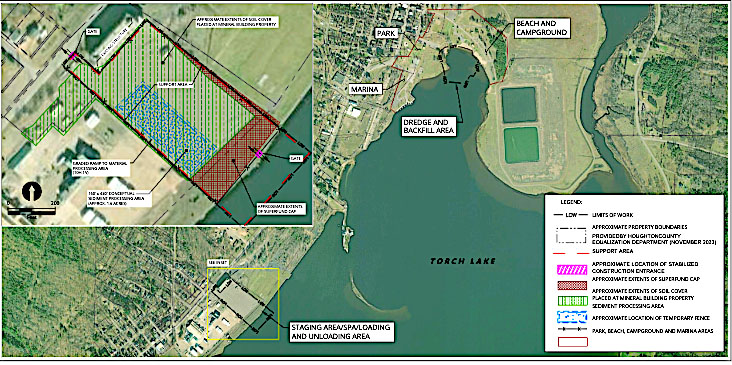
Map courtesy of TLPAC Much of the focus of the 2026 Torch Lake cleanup projects will focus on the Torch Lake Recreation Area.
LAKE LINDEN – The Torch Lake Public Action Council (TLPAC) has announced an Open House hosted by the department of Environment, Great Lakes, and Energy (EGLE) and the Environmental Protection Agency (EPA) from 4-7 p.m. April 16 at the Lake Linden-Hubbell High School.
The event will focus on the Lake Linden Recreation Area (LLRA) cleanup for 2026 and will include the drum pilot results.
Franklin Township Supervisor and TLPAC Board Member Mary Sears said EGLE and the EPA will provide an overall update on the cleanup projects, including the barrels that were located in the lake and their removal, as well upcoming cleanup actions in 2026.
The cleanup will consist of the removal of approximately 13,300 cubic yards of sediment contaminated with polychlorinated biphenyls (PCBs), lead, arsenic and zinc from the LLRA. It is anticipated the cleanup will take place in 2026 with work being performed from late May or June through October.
According to the Torch Lake PAC Spring Newsletter, the Lake Linden Recreation Area campground and marina will be open and accessible throughout the cleanup, however, the immediate area of the LLRA beach will be closed for the season.
Fencing will surround the beach area, according to the newsletter. There will be barges noted off the shoreline of the recreation area with an excavator present on the barge to dredge sediment. Scows will transport dredged sediment to a staging area located north of the existing Koppers facility where the material will be offloaded for processing. Contaminated water resulting from dredged and dewatered sediment will be proceed through an on-site treatment plant and discharged back to Torch Lake according to permit requirements.
Dewatered material will then be transported to a landfill for final disposal. Additional truck traffic will be present later in the summer as transportation of material to the landfill takes place
The EPA completed a Drum Removal Pilot Study in the Hubbell Processing Area (HPA), which is the former site of the Calumet and Hecla copper processing facility. The area is contaminated primarily by high levels of copper, heavy metals, PCBs, and polycyclic aromatic hydrocarbons in the sediments and shoreline. The EPA refers to the location as a Torch Lake Area of Concern (AOC).
In Sept. 2024, EPA contractors removed 100 drums, debris and sediment from three areas at different water depths and performed extensive monitoring and sample collection. Contaminated sediment and other debris were removed from the three target areas. The removed drums, sediment and debris were temporarily staged at the former Mineral Building property before being transported to a disposal facility.
Sears said other cleanup projects will also be discussed, including what she calls bio projects, which involve various plants.
“They’ve reintroduced some native (plant) species to see if they clean up the water,” she said. “They did a reintroduction of species through that area to try to facilitate the cleanup of the area, because nothing grows there. So, they have to stabilize the area and get something to grow there, so eventually it will expand and continue along the way, because that’s what cleans your lakes.”
In 2003, EPA, the Natural Resource Conservation Service (NRCS) and MDEQ planted around 15,000 fast-growing plants on the island to determine if they would grow without the addition of clean soil cover. EPA has closely monitored this project. In 2004, an additional 20,000 plants were planted.
“They did that with different things and they had some that work and some that didn’t,” said Sears, “so they’re going to give some updates on that.”
Front Page

Meth suspect remains jailed
Torch Lake Cleanup

A local connection
UTV death in Marinette Co.
STEPHENSON — A utility task vehicle (UTV) crash on Marinette County's Caldron Falls Road near Fawn Lane Saturday ...
Meth Lab in Houghton County