
Addressing the issue at Buffalo Reef
Keweenaw Bd. hears stampsand proposal
Trending
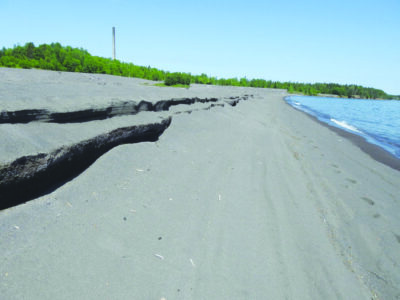
EAGLE RIVER - At its regular meeting Wednesday, the Keweenaw County Board of Commissioners hear from Jay Parent, district supervisor for the Water Resources Dept. of Environment with the Michigan Dept. of Environment, Great Lakes and Energy (EGLE). Parent discussed a multi-phase proposal for containing the stamp sands along the Lake Superior shoreline at Gay, deposited by a mining company stamp mill.
"The problem with the stamp sand is when its in water," Parent said, "the copper's released, and it's toxic to aquatic organisms. The waves are moving it and pounding it, and it's leaching all the copper coming off the shoreline. So, that's why we want to get it out of the lake and get into a (safe) spot."
In 2019, the Buffalo Reef Task Force (BRTF) identified 13 potential alternatives to remediate the stamp sands and restore the habitat. All but three were subsequently eliminated.
In 2024, the BRTF issued a draft alternatives analysis for disposal of stamp sands removed from the area around the natural 2,200-acre reef.
The three alternatives considered in the analysis include:
• Building an in-lake barricade around the original stamp sands pile to contain it. Parent said this option was opposed by the Keweenaw Bay Indian Community (KBIC) and the DNR Fisheries Division, saying Lake Superior as a whole is an ecosystem, with fish and other organisms in deep water. "Moving it from one part of the lake to another might not be very prudent," said Parent.
• Disposing of stamp sand in a nearby upland landfill
• Hauling the material to the mine tailings basins at the former White Pine Mine in Ontonagon County
Parent said the White Pine option was eliminated because the tailings basin is not large enough, and Kinterra Capital, which owns the site, is planning to operate the mine.
The task force ultimately decided on pursuing construction of an upland landfill for disposal of stamp sands. In addition, a 2,000-foot-long jetty would be constructed to intercept the stamp sand as it migrates south.
This would be a Type III landfill, said Parent, a specialized, highly regulated waste disposal facility designed strictly for non-hazardous materials, primarily construction and demolition (C&D) debris and industrial waste.
Parent said the proposed landfill is a 14-acre composite-lined area. Nearly 23 million cubic yards of the mining waste was originally deposited in Gay near the Mohawk Mine. Over the years, about 10,000 to 20,000 cubic yards of the sands have been reused to provide traction on winter roads. But more than 90% of it has washed offshore, where currents have deposited it on the reef.
"That would get us 500,000 cubic yards of material. Dredging 100,000 per year, which has been done twice, would fill the area in five years," he said. "It gives us a spot to put it. It's phased, it's an expensive project. It's not all going to come at once. So, we're just going to do a little spot first."
The most recent cost estimate for completing the long-term project is $2.1 billion over the length of its timeline.
Parent said the estimated cost of building a jetty ranged from $120 million to $450,000 million.
"I know it's a lot of money," he said, "but, it will kind of come in pieces."
Board of Commissioners Vice President Del Rajala commented, asking if all the hurdles are met to allow for the Type III landfill to be created, who is going to own it, who is going to maintain it, and who is going to be responsible for it.
"That's huge," he said, "and if something goes wrong, who's on the hook to fix it?"
Rajala said he asked the questions because when the Air Force abandoned the radar base on Mount Horace Greeley, the site was so extensively contaminated the water in that area is not potable.
"We just got left with a mess," he said, "so I'm making sure that if this happens, these questions can be addressed, so the answers can be locked in so we're not left with another mess."
Parent said the way the project will be constructed, if Phase 1 is abandoned, it would only require a liner and a cover, and the pile of stamp sand stays in the woods.
Parent said the person operating it would be the one to fix it, regulated by the Materials Management Division of EGLE.
"We don't know who would own and operate it," Parent said. "We are exploring purchasing the property, because we're a little nervous that we're spending so much money on designing it, we don't want the current owner to quote $6,000 per acre, so, right now, we're engaging with the State land bank to get it."