
Cora Reynolds Anderson: L’Anse woman first female MI House representative
Daily Mining Gazette
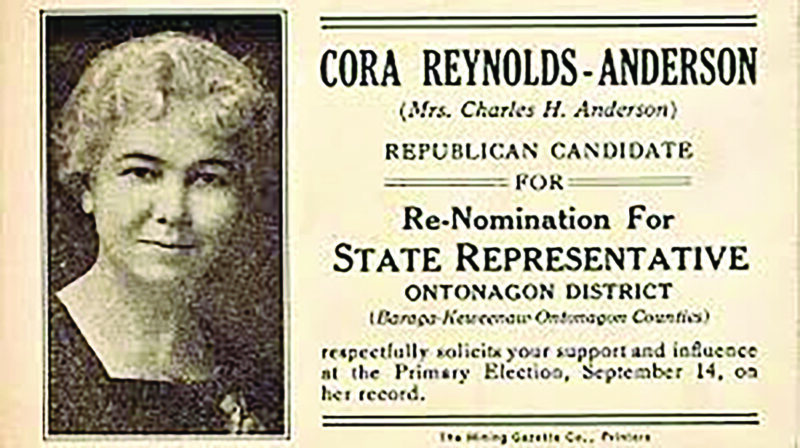
An ad for Cora Reynolds-Anderson’s reelection bid as it appeared in the Daily Mining Gazette.
L’ANSE — Cora Reynolds Anderson blazed a trail as a state legislator and also made her presence known as a health official and farmers’ advocate.
Anderson, of L’Anse, became the first woman in Michigan’s House of Representatives, and the first Native American woman in any state legislature, when she joined the House in 1925.
Born in L’Anse in 1882, Anderson was a member of the L’Anse High School’s first graduating class. She was later educated as a teacher at the Haskell Institute in Lawrence, Kansas, now known as the Haskell Indian Nations University.
She returned to the UP and taught at the Zeba Mission. (Decades later, the Michigan Women’s Hall of Fame would laud Anderson’s “determination to attend college and return the benefits of her education to her community,” especially during a time of widespread discrimination against women and minorities.)
Anderson and her husband, Charles, would operate an inn in L’Anse in the early 1900s. She took an interest in public health, organizing the first public health service and obtaining the first public health nurse for Baraga County.
She was also active in the Grange, an agricultural organization advocating for farmers and rural residents.
She held office with the state Grange organization for eight years starting in 1910, and later took charge of its educational work in the Upper Peninsula.
In 1924, Anderson ran unopposed for the Michigan House’s Iron District, which consisted of Baraga, Keweenaw, Ontonagon and Iron counties.
While still promoting agricultural interests, Anderson wasn’t afraid to split from the Grange when she felt it necessary. She backed an amendment restricting child labor laws, which the state Grange had opposed.
Joining an otherwise all-male chamber, Anderson took pains to be treated like any other member. A Detroit Free Press profile after her swearing in approvingly stated Anderson wasn’t a “faddist” who would press “the so-called woman’s legislation.” She also told her colleagues in the House they didn’t need to stop smoking around her.
Anderson said she planned to emulate the “golden silence” of then-President Calvin Coolidge, a fellow Republican.
“I don’t expect to get terribly excited over every little bill that is introduced, but when things come up which involve principles and human relationships, I may be heard from,” she told the Free Press.
And she was heard from. She introduced six bills during her term in office, including licensing for beauticians and cosmetologists, Native American fishing rights in Huron Bay, accounting and reporting in township offices, and regulating sanitary conditions in hotels and inns.
Anderson also advocated for combating alcoholism and the tuberculosis epidemic.
She still had to contend with people amused at the notion of a female politician. Reactions to her hotel bill — including the then-new requirement for hotels to change bedsheets after every guest — included an article calling her “the first practical bed-maker in the Legislature,” complete with mocking quotes from anonymous fellow legislators.
Anderson was tapped to chair the Industrial Home for Girls Committee. She also served on the committees for agriculture, insurance and the Northern State Normal School, which later became Northern Michigan University.
She would serve only one term in the House, losing a contested race after her district was changed due to redistricting.
Anderson would later move to Bay City, where she assisted her husband in his work as a Prohibition agent. She died in 1950.
Anderson’s impact continues to be felt nearly a century after she was elected.
In 2001, she was named to the Michigan Women’s Hall of Fame. That came the year after the building housing the Michigan House legislative office and committee rooms was named in her honor.
U.S. Sens. Gary Peters and Debbie Stabenow co-sponsored a bill naming the Baraga Post Office after Anderson, which President Joe Biden signed into law in December.
Baraga County is now represented in the house by Jenn Hill of Marquette. After news of the bill’s signing, she said she was proud to see the recognition of her predecessor.
“I think it is somewhere where the community comes together and it’s important to recognize, and I’m honored to be following in her footsteps,” she said.
Susan LaFernier, a member of Keweenaw Bay Indian Community’s Tribal Council, proudly noted Anderson had taught at the Zeba Indian Mission M.E. Church, of which LaFernier has been a lifelong member.
“She has been an inspiration to the people of our Tribe,” she said. “Keweenaw Bay Indian Community will honor her greatness and memory for generations to come.”