
F1 Review: 2026 preseason testing
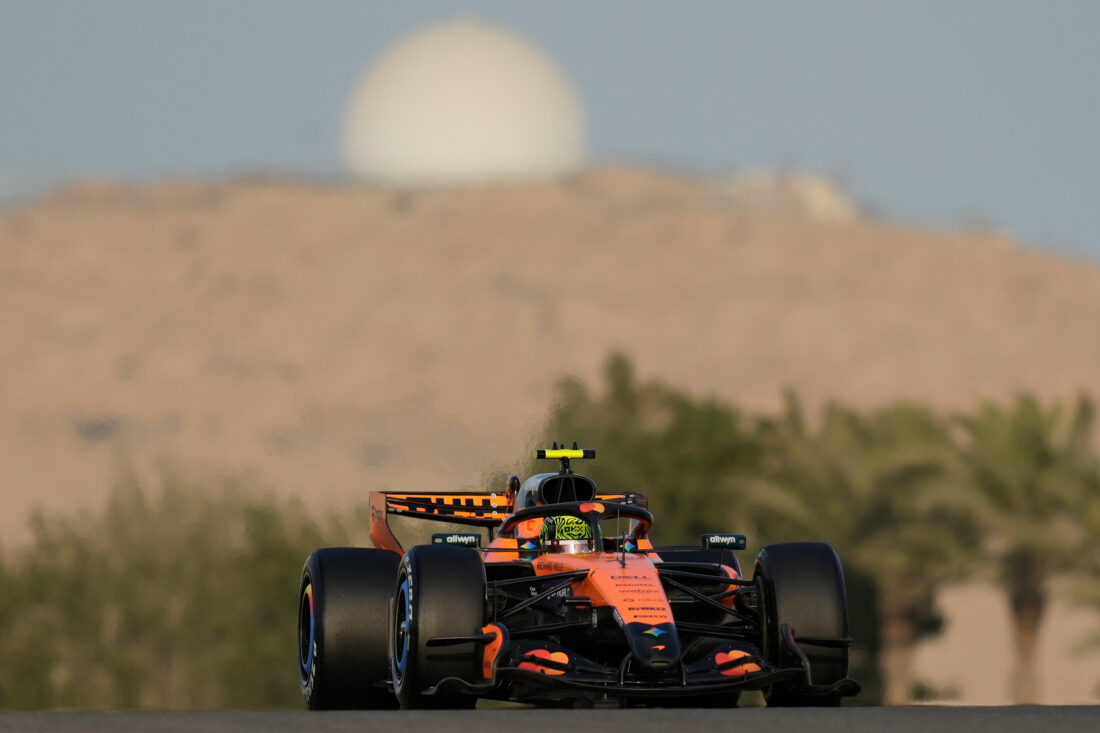
McLaren driver Lando Norris of Britain steers his car during a Formula One pre-season test at the Bahrain International Circuit in Sakhir, Bahrain, Wednesday, Feb. 11, 2026. (AP Photo/Altaf Qadri)
BAHRAIN — Most professional sports have preseason events, and Formula 1 (F1) is no different. While organizations like Major League Baseball, the National Football League, and other similar team-based sports have structured and competitive games in the preseason, racing like F1 is different in only doing testing in the preseason.
Starting back in 2009, the rules for F1 tried to cut back on the costs it takes to compete in the sport by strictly limiting all testing during a season, both preseason and in-season. The latter was eliminated in 2014 making preseason testing crucial for teams. From 2021-25, preseason testing was limited to a single three-day test.
For those who are into F1 enough to get excited about preseason testing, 2026 was a boon. They opened preseason testing up to three separate sessions for a total of nine days of preseason testing.
Why would F1 triple the available preseason testing for teams? Because major rule changes, the largest in a decade, were put in place that dramatically changed the cars in a variety of ways.
The most visible changes are the wings with fewer elements overall, but more importantly, both front and rear wings are adjustable with what is called “active aero.” In specified sections of the track, drivers can switch the configuration of the wings to provide more downforce for better cornering, or to reduce downforce or provide lift to give more top speed on straights.
In years past, there was just a Drag Reduction System (DRS) element that activated in particular sections of each track only if a car was within one second of the car in front of them. Now, there are more dynamic changes available throughout a lap all in the control of the driver.
Overall, the cars are also shorter, narrower, and lighter from previous years. There are new required barge boards that stick out behind the front tires which will help prevent teams from “outwashing,” which means they push the air out and around their car, creating more “dirty air” or more turbulent air for the cars following behind. This will allow cars chasing other drivers to stay closer and hopefully increase the competition on track.
Even though we lose the DRS, there are still incentives drivers have to get close and attempt passing including a boost button, an overtake mode, and recharge controls. Boost is available to drivers at any time they want it as long as they have the battery charge available.
Overtake mode essentially replaces the DRS of old since a driver has to be within one second of the car in front to earn it. The main difference this season is there is only one detection point, and then an extra battery charge is available to that driver throughout the entire lap, wherever they want it instead of just in a specific straight like before.
Drivers have to stay on top of their battery charge to make sure they have the power capacity to go faster when they want it. The make-up of the hybrid engines in the cars is different now too with a shift to basically half of the power coming from an internal combustion engine and the other half coming from an electric motor.
With changes to the aerodynamics outside of the car, changes to the makeup of the innards of the car, and changes to the way drivers can interact with their cars, more testing time was carved out. The first round was in Barcelona when teams could put their cars on track any three of five days on offer (Jan. 26-30). Little information was revealed from this testing though as media coverage was restricted. Then, two separate testing sessions took place in Bahrain from Feb. 11-13, and 18-20 which were available for everyone to watch from the comfort of their homes.
So, what did preseason ultimately tell us? The cars seem slightly difficult for drivers to handle overall as they finally get to see what the new moveable wing features and aerodynamic changes do to their cars. Every single driver missed braking points and went too deep into corners at some point during the testing as they played around with these new features.
But, take all of those things with a grain of salt. They weren’t really racing one another yet. Things are bound to change drastically when the green flag flies in the first race, but here is a brief team-by-team rundown from preseason.
Quick note: I’ll provide the total number of laps each team was able to complete between their two drivers combined. During these testing times, only one driver per team could be in a car for any given session. In a regular race weekend, a driver might complete about 170 laps between three practice sessions, qualifying, and the race. Over a 24-race season, a driver would then complete somewhere near 4,000 laps total.
That should help give perspective on what the teams accomplished during these test sessions when they’re testing the reliability of all these new components on the car, and the drivers are trying to get accustomed to their new rides.
Mercedes (Mercedes engine) started off strong with 1,214 total laps from their nine days of testing. Widely accepted as the fastest car, they have a lot of interesting unique aerodynamic elements which might give them an edge. Whether or not they are the actual fastest, or if that can translate to winning races this year, they are solidly in the top four with minimal disruptions to their running so far.
Haas (Ferrari engine) was a surprise second place in total laps completed with 1,185. They usually had a car in the top half of the pack on the time sheets, but the team has yet to score a single podium since they started in 2016. Is this the year they break that drought?
Ferrari (Ferrari engine) was only four laps behind Haas overall with both drivers seeming more comfortable driving this car than last year. While Lewis Hamilton managed to win the Sprint Race in China in 2025, it was the only real high point of the season for the team. An innovative rear wing that, instead of lying flat in its alternate position like every other team, actually spins 180 degrees to provide lift like an airplane wing shows they’re all in on trying to find an edge in 2026.
McLaren (Mercedes engine) won the Constructor’s Championship easily in 2025 but nearly lost the Driver’s Championship, just squeaking out a win for Lando Norris. They do not expect a repeat performance of dominance in 2026, but feel they are still at least in the top four of teams on the grid. They managed 1,105 laps throughout preseason testing with very few mechanical issues on their cars.
Racing Bulls (Ford engine) impressively completed 1,051 laps in preseason testing. They have the only rookie driver in 2026 with the promotion of Arvid Lindblad from F2. He and his teammate Liam Lawson managed to get through most everything the team wanted to in testing and feel they’ll be competitive in the midfield this season.
Alpine (Mercedes engine) had a miserable season in 2025, coming in last in the Constructor’s Championship with only one driver scoring any points. A switch in engine manufacture and some innovative cooling methods in their car have them hopeful for 2026, as does their ability to complete 1,024 laps in testing.
Red Bull (Ford engine) promoted Isack Hadjar to team up with Max Verstappen for 2026, but testing gave little indication how that will pan out this season. The team had a few mechanical issues which limited them to just 975 laps over the nine days. That translates to over 3,000 miles, so it’s all relative, but with a brand new engine partner, they would’ve liked things to go more smoothly.
Audi (Audi engine) took over the bright green Kick Sauber team from 2025 and retained both drivers for this season. Ambitiously, they built their own car and, despite some growing pains associated with that, managed 953 laps in an impressive testing program.
Williams (Mercedes engine) managed to get in 790 laps which, while that is well behind the previous eight teams, can be tempered with the fact they missed all testing days at Barcelona because their car was not ready yet. So, with two-thirds of the testing time compared to their rivals, they were happy to not have the fewest laps and have the reliability to turn in so many laps in Bahrain.
Cadillac (Ferrari engine) made it to all nine days of testing but only managed 750 laps total. They built a completely new car as this is their first year in the sport, but did take the quicker option of buying a Ferrari engine instead of building their own. While the plan is to build all their own components, including engines, in the future, 2026 is all about getting to the end of the races and trying to get some points.
Aston Martin (Honda engine) ended last season as the talk of 2026. Once they secured the work of Adrian Newey, considered one of the best ever aerodynamicists in F1, and got an exclusive deal with Honda, the potential was through the roof. Unfortunately, their lap completion rate in preseason showing was more at the basement level as they managed an even 400 laps total. They only ran two of the three days in Barcelona, logging just 5 laps one day, and managed just 6 laps on the last day in Bahrain. While the team has some optimism of improving throughout the season, early indications are that they have a long way to go to be competitive.
What looks like it will be quite competitive are the race starts. Simulated starts in preseason testing showed Ferrari powered cars rocketing by opponents as they are able to get energy out of their cars far quicker than their opponents. Once again, we don’t know how that will translate to race days as the season gets underway, but it looks to be exciting.
Speaking of race day, the first one comes our way Saturday, March 7, starting at 11 p.m. when the cars will race one another in Australia. For the next three years, F1 will exclusively be broadcast on AppleTV in the United States. Strap in and get ready for what could be some very action-packed racing in 2026.
National Sports
Speed and paddock politics: George Russell aims to seize his chance after F1’s big changes
WNBA’s new CBA offer boosts pay, fast-tracks max deals for stars like Caitlin Clark, AP source says
NEW YORK — The WNBA sent a new CBA proposal to the players' union Sunday night that includes allowing some of its ...
F1 Review: 2026 preseason testing
Chris Gabehart shows up in Spire gear as a lawsuit court deadline looms
Italian skier Sofia Goggia wins super-G to regain commanding lead in World Cup discipline standings
SOLDEU, Andorra (AP) — Sofia Goggia won her second super-G of the season Sunday and regained a commanding lead in ...
Cowboys place franchise tag on George Pickens as focus shifts to talks on a long-term deal
The Dallas Cowboys placed the franchise tag on George Pickens on Friday, a move that could guarantee the receiver ...