Tests show no toxins in area algae blooms
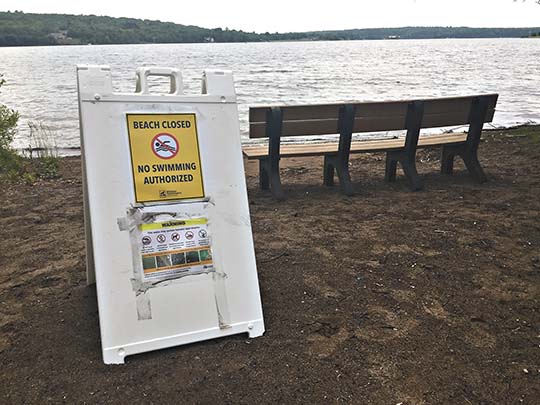
Garrett Neese/Daily Mining Gazette A sign with a recreational health advisory warns prospective swimmers away from Prince’s Point on Monday due to potentially harmful algal blooms. The Western Upper Peninsula Health Department lifted the advisory Thursday after test results showed the blooms tested negative for toxins.
HANCOCK — The algal blooms that have popped up in area waterways recently showed no signs of toxins, test results show, the Western Upper Peninsula Health Department said Thursday.
WUPHD issued a recreational health advisory for Portage Canal, Portage Lake and Torch Lake on June 30 after receiving several complaints about the algae. That advisory has been lifted, though Environmental Health Director Tanya Rule said people should still avoid recreational activities if they see an algal bloom or discolored water.
Even non-toxic algae can cause problems such as skin irritation in humans, Rule said. But toxic kinds can cause problems such as kidney and liver damage, and in numerous instances have killed pets and other animals that ingested them.
In tests conducted by the Department of Environment, Great Lakes and Energy (EGLE), the three local samples tested negative for three toxins: microcystins, Anatoxin and Cylindrospermopsin.
The genes that regulate toxin production can turn on or off at any time. Even the state toxicologists still don’t know why, Rule said.
The initial algal bloom has also gotten smaller, she said.
“It could change day to day, depending on the conditions,” she said. “That’s why we still want the public to continue notifying us if there are more visible algal blooms, because the state will come back and test.”
The blue-green algae, a cyanobacteria, is making its first appearance in the Copper Country, Rule said. They are more common in Lake Erie and in western states, where lakes are shallower and warmer. Last year, an outbreak of algal blooms in Toledo, Ohio affected the municipal water supply.
“That’s why the state was quite prompt to step in with the sampling, especially with the situation in Ohio,” Rule said.
The sunny and abnormally warm weather helped the bloom, Rule said. Some rain events have also helped wash nutrients into the water, she said.
“We have just noticed that all the swimming beaches are dramatically warmer than in past years,” Rule said.
In some spots of the Portage Lake, surface water temperatures were around 86 degrees Fahrenheit, said Cory McDonald, an assistant professor at Michigan Technological University. McDonald deployed a monitoring buoy in Portage Lake in June, which is providing data about the blooms.
As temperatures warmed, wind also dropped to extremely low levels, McDonald said. The algae levels began dropping again on Tuesday, when the wind shifted and picked back up, he said.
“Normally, the top layer absorbs heat and that gets churned under a bit, mixed through the lake,” he said. “But without that wind, in combination with the really warm air temperatures, it provided the perfect context for the top layers to heat up fast.”
Though still rare, the algal blooms could become more common in the region with warmer waters, McDonald said.
Mike Sayers, a research scientist at the Michigan Tech Research Institute in Ann Arbor, has used ocean color imagery to measure water quality by analyzing the light’s relationship to particles in the water to analyze what they might be. With harmful algae, they’ve used remote sensing with recurring events in Lake Erie to estimate the amount of chlorophyll, the pigment which accounts for the green color of algae.
Since bloom monitoring began in Lake Erie in 1998, they’ve seen a long-term increase, though it has leveled off somewhat in recent years. The size of the bloom can partially be predicted by river runoff, which serves as a “firehose of nutrients” from agricultural areas.
“If we have a really wet spring where we have a lot of those nutrients being pushed into the lake, we typically have a larger-than-usual bloom,” he said.
More chlorophyll and biomass does not necessarily mean more toxins, Sayers said. One clue can be the presence of “surface scum,” made up of cyanobacteria that float to the surface in calm waters.
Researches are working to build better prediction models, Sayers said. One factor is the life cycle of the algae; they are more likely to leach toxins as they die. Hyperspectral sensing, which would record colors from ultraviolet to near-infrared, would also allow researchers to see specific pigment features and absorption rates.
“Theoretically, we should be able to do a lot better job of differentiating harmful algal blooms from non-harmful algal blooms,” Sayers said.
Current water-quality results and beach advisories are available at egle.state.mi.us/beach.
Front Page
Finno-what? Hancock: The first Finno-Ugric capital across the ocean
There’s been much talk about “Finno-Ugric” this past year in the Copper Country. The first part might ring a ...

Heartlands Board Readiness Subcommittee to hold informational meetings

Researchers head to Superior Maximus to investigate ‘zombie’ fish

All good things come to an end

Time for a decision