
Safety course trains 21 new outdoorsmen
Trending
Phoenix -- The Upper Peninsula will welcome 21 newly educated hunters from the Calumet-Keweenaw Sportsmen's Club's Hunter's Safety Course held last Thursday through Saturday. The Club held the course for its third year to educate and allow the participants the chance to obtain the ability to hunt.
The course teaches budding outdoorsmen the ethics and safety of hunting along with skills that one may find useful when practicing the sport in the wilderness. The students were of all ages, with the youngest being 5 years old and the oldest in their 30s.
The course was a three day program with the first two days of classes in the club house and the final day consisting of a test and field activities.
Calumet-Keweenaw Sportsmen's Club President Tom Helppi said the Club offers this course to give back to the community.
"We want people to be able to value hunting and to be able to get out there and do that safely," Helppi said.
During the classes the students learned about ethical hunting and environmental practices, firearm safety, basic Michigan hunting regulations and awareness of one's surroundings in the outdoors. Some examples of the ethical and safety practices when hunting is where to aim a firearm at a deer to ensure the least amount of pain and suffering inflicted and when to know if it is safe to shoot the target game animal given the surroundings the animal is in. Everything that was taught in the club house was comprehended by the students as all of them passed their tests.
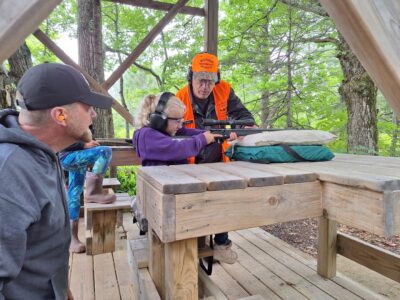
After the test the students practiced what they had learned outside in a variety of stations overseen by the instructors. The stations taught firearm handling when unloading or loading them into a vehicle, how to safely cross a fence with a firearm, how to safely ascend and descend a tree stand, what to look for in the wilderness to know if it is safe to shoot or not and a chance to shoot a rifle at the club's firing range while demonstrating firearm safety practices.
The stations with exception of the firing range used fake firearms to ensure the students' safety, but they were all expected to treat the firearms as if they were loaded to learn the constant awareness one must practice while handling a weapon. This was emphasized by requiring the students to ensure that the firearms were not loaded every time they handled the fake weapons by checking the chambers where a round would be inserted to. Having the barrel of the firearm pointed at anyone despite the weapon not being able to fire was not tolerated.
The instructors would give a brief demonstration and explanation of what the students were expected to execute, and then they would get to practice the skills they were taught over the three days of the course. The firing range was where everything that was learned about firearms was applied, with the shooters needing to show they understood the need to ensure the safety was on, that the firearm was performing properly, keeping their fingers off the trigger of the rifle until ready to fire and the slow squeeze of the trigger when firing. Once the field activities were completed, the students received their certificates and returned home.
Some of the students comprised of a family, with two of the members being the youngest and oldest of the whole class. Nadine Ruonavaara obtained her certificate alongside her daughters Kinsley and the youngest of the class Miranda Walker. Their father Randy Walker was at their side observing the class and field activities the new hunters partook in. Kinsley has been hunting for the past two years, but this was the year she needed to obtain her hunter's safety certification. Miranda may be waiting another year before she is hunting, but her parents emphasized the it was important for her to begin obtaining knowledge about safety.
"It's important to be in the outdoors, do stuff together and provide food for the family," Randy said.
Ruonavaara agreed and added, "It's always been a family thing every fall."
Miranda expressed an interest in hunting bears while her sister Kinsley was excited to go deer hunting.
When and how the 21 new hunters can begin depends on their ages. In the state of Michigan a child under 10 years old can hunt as a mentored youth hunter. The child must obtain a license first but then can hunt as long as he or she is with a mentor hunter. The mentor hunter must be at least 21 years old and have hunting experience and possess a Michigan hunting license. While in the field, the youth hunter must always be within arm's length of the mentor hunter and there is a limit of two weapons per mentor.
Children 10 years and older must acquire a base apprentice license. These apprentice hunters must be accompanied by another hunter who is at least 21 years old and possess the same game license as the apprentice hunter. The older hunter must be a parent, guardian, or someone appointed by the parent or guardian. The older hunter must always have the apprentice hunter within his or her vision, be at a distance allowing he or she to be able to come to the aid of the apprentice hunter and can have no more than two apprentice hunters while hunting.