
Copper Country holds place of primacy in U.S. history
John Jacob Astoer, Curtis Grubb Hussey were key players
Trending
Editors note: The Daily Mining Gazette, in cooperation with other Upper Peninsula newspapers is running companion pieces to our America 250 stories with a focus on the U.P.’s role in building America
COPPER COUNTRY -- When most scholars of U.S. history study the birth and growth of the country, very few of them consider the Upper Peninsula's contribution to the rise of the nation. And yet, it is so. John Jacob Astor organized the American Fur Company, with its headquarters on Mackinac Island, in 1808, when the western Upper Peninsula was part of Indiana Territory.
The Upper Peninsula was crucial to the Fur Trade and became a staging area for Astor's westward expansion. The peninsulas that became Michigan were so important to the Fur Trade they were the primary objectives of the French, British and American colonists in the Seven Years' (French and Indian) War.
One of the most influential individuals of the War of 1812 was John Jacob Astor, who financed the U.S. war effort to prevent government bankruptcy. U.S. victory would ensure that Astor retained his monopoly of U.S. fur trade. While Astor's traders traversed the Upper Peninsula, they brought reports of the presence of copper back to Astor at Mackinac Island.
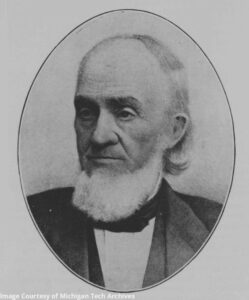
Just three and a half decades later, the western U.P, now part of Michigan, would find itself in mining news around the world, with the opening of the Cliff Mine, in what became Keweenaw County, under the leadership of Pittsburgh pork and dry goods dealer Curtis Grubb Hussey. Hussey first became interested in the Lake Superior copper region in 1844 when he invested heavily in the Pittsburgh and Boston Mining Company, which owned the Cliff Mine, on Keweenaw Point. Hussey also
organized many of the first mining ventures along the Keweenaw Peninsula, including the Cliff, the North Western and the Central mines, on Keweenaw Point, and in the Ontonagon district, National, the Aztec, the Forest, the Adventure mines, and a host of others.
Hussey's interest in Michigan mines was not corporate profits, although they were a bonus. Hussey's objective was the copper the mines produced. Hussey purchased a vast majority of the copper his mines produced. Shipping it to his rolling mills in Pittsburg, where Hussey, in 1848, built a national copper and brass market. His Pittsburg company was the C.G. Hussey & Company Copper and Brass Works.
George Thurston's 1857, book, “Pittsburgh as it is,” stated the relationship between Pittsburgh and the copper region that was integral to both. "The attention is first naturally drawn to the Pittsburgh Copper Smelting Works, from the location of this establishment here." The works, he stated, were built in 1848 for the purpose of converting into ingot and cake copper the minerals of the Pittsburgh and Boston Mining Company, produced at is mines on Lake Superior.
According to the Biographical Dictionary of American Business Leaders, Volume 2, Hussey's mill was the earliest of its kind west of the Alleghenies. Hussey was also the first in the country to supply American copper in large quantities to manufacturers.
In Pittsburg, Hussey faced a refinery problem new to mining and mineral processing. The copper from the Cliff and National mines was found in masses weighing as much as several hundred tons. Hussey solved the problem by borrowing from Welsh smelting technology, building a reverbretory furnace with a removable top, through which copper masses could be lowered via an overhead crane. The furnace, however produced much copper-bearing waste in the form of slag. To
capture the lost copper, Hussey installed a cupola furnace near his reverberatory furnace, and smelted his own copper slag.
In this, Hussey developed a method to improve copper refining, creating a model for American smelting that was widely adopted and is still used today. Hussey was confronted with another problem: There was only one commission house in the U.S, through which he could buy and sell copper and copper products. Hussey created his own commission, complete with a warehouse of manufactured products and materiel waiting to be shipped to clients. Hussey had by-passed the New York
copper commission and found his own clients. In doing so, Hussey and his rolling mill became the first vertically integrated industrial company in the United States. Hussey's copper mill provided essential, specialized fabricated parts to the nation during the rapid expansion of railroads, machinery, and manufacturing.
But Hussey wasn't done yet. Relying on the copper refining process he had revolutionized, the C.G. & Hussey Company expanded from smelting and rolling copper to manufacturing crucible steel. This led to the organization in 1859 of the Hussey, Wells, & Co. Of Hussey's partners, Calvin Wells, Thomas M. Howe, and James Cooper, Howe and Cooper were
also his partners in the Cliff mines and the copper works. Hussey, Wells, & Company was the first firm in America to successfully make crucible steel.
The Hussey & Wells Co. company overcame technological hurdles to produce crucible steel, which was superior in hardness and strength to previous materials. Their crucible steel was vital for manufacturing tools, agricultural implements, and components for railroads and railways.
By improving upon English crucible steelmaking processes, the company reduced American reliance on foreign steel imports. As he did with acquiring copper, Hussey played a significant role in the development of the Michigan Iron mining industry through which he obtained much of the iron for his steel production. Hussey, Howe, Cooper and Wells and their development of the Michigan copper and regions, were indispensable figures in U.S. industrial expansion, with partnerships linked to significant copper and iron mining ventures, further aiding the technological evolution of the
era.