Copper Country pioneer personification of immigrating Irish

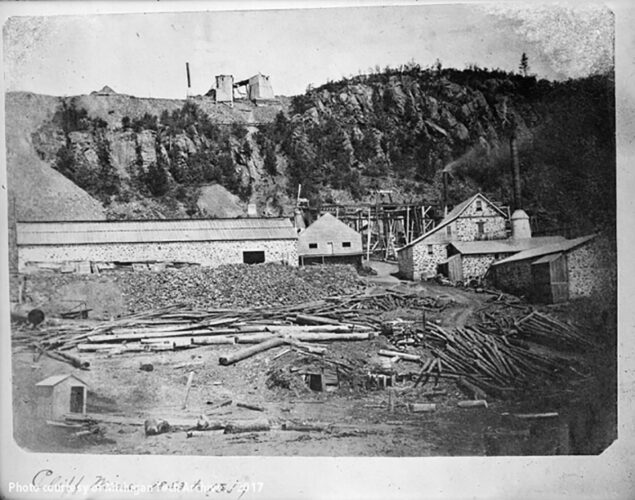
MTU Archives
This photograph, taken between 1853 and 1857, shows the Cliff Mine as it appeared when the O’Shea family arrived to work there. The buildings on the left are the engine house for the stamp mill behind it. On the left is the wash house, where the copper was separated from the stamped mine rock.
Castletownbere, or Bearhaven, was, and is, a regionally important fishing port, nestled between the Atlantic Ocean and the Caha Mountains. Located on the southwest shore of the Beara Peninsula, in the 19th century, the Castletownbere and the Bearhaven Harbour was a naval port for the British Navy.
Mining on the peninsula dates back to the Bronze age, 1,400-1,000 BC. Mining on the neighboring Mizen Peninsula began a millenium earlier. Modern mining began on the Beara Peninsula in 1812, when landowner, John Puxley, established a company at Allihies, about 12 miles from Bearhaven. Thousands of residents from across the region of Munster came to the Beara Peninsula for work in the Allihies mines.
Des Cowman’s journal article, “Life and Labour in Three Irish Mining Communities circa 1840,” which appeared in the Irish Labour History Society’s 1983 edition of Saothar Journal, states that the entire town of Castletownbere developed six miles from Allihies as a port to service the mines.
It was into this 19th century world that Timothy O’ Shea was born in 1843. Shea, along with his brothers, and like most boys of the British Isles, followed his father into the mines, which like the rest of Ireland, were under the supervision of English landlords. When John Lavillan Puxley opened the mines, on 9,000 acres of land that were part of his estate, he recruited miners from Cornwall to manage them.
Puxley, though born in Ireland, was from a Welsh family who received estates during Queen Elizabeth’s war on Ireland in the 18th century. West of Castletownbere lay the ruins of the 15th century Dunboy Castle and the 19th century manor house built by Puxley. The lands were originally held by Donal Cam O’Sullivan, who joined the war against Queen Elizabeth’s rule. To make a long story short, in 1602, during the Nine Years’ War, the castle was destroyed by British artillery, and its defenders were executed on the public square. When Cromwell later invaded Ireland, the ruined castle was fortified. Puxley later built a manor home near the castle that was typical of manors of that time.
O’Shea was not old enough to grasp the impact the copper mines in Chile had on the British copper market in the mid-1840s. They mined ores similar to that of Beara. Chilean copper depressed the world copper market, which all but devastated U.K. copper prices.
Historian William H. Mulligan, in his 2001 journal article, Irish Immigrants in Michigan Copper Country, reported that while Puxley provided free housing, high wages and other benefits to his company’s Cornish miners, the Irish employees lived largely on the potatoes they grew in small plots in the villages that surrounded the mines, and on wages of one-third to one-fourth those paid to the Cornish. While the Chilean mines were contributing to declining copper prices, the mines of the Lake Superior copper region were being reported in English newspapers; it was during this time that Ireland was rocked by the Great Famine. Timothy was not yet three years old.
Des Cowman wrote that the famine was a turning point not only in its direct consequences, but also in that it created a general awareness of the work potential oversees.
Mulligan, in his 2004 article, From the Emerald Isle to the Copper Island: The Irish in the Michigan Copper Country, 1845-1920, wrote that miners from both Cornwall and Ireland began to emigrate in significant numbers because of the concentration of industry and and declining incomes.
“After the middle of the 1840s,” Mulligan wrote, “the U.S. market declined sharply as a place to sell British copper as production in the Lake Superior district swelled. This further increased the number of miners willing to emigrate as small, marginal mines closed when prices fell.”
Many of Beara’s early emigrants arrived in Boston and Fall River, Massachusetts, according to Mulligan. Boston, he wrote, appears to have been the prime destination for people leaving the principle mining area in the Beara Peninsula. This is probably the route taken by O’Shea and his family.
In 1856, at the age of 13 years, Timothy, and almost certainly his father, went to work on the Hoosac railroad tunnel, which was being built to connect Boston and upper New York state. The O’Sheas did not stay in Boston long. Less than a year later, they were both working at the Cliff Mine on Lake Superior.
It is likely Clifton was their destination originally, but worked on the Hoosac just long enough to raise funds to continue their journey. There were already many others from Beara at Clifton before the O’Sheas arrived there in 1857, and it is probable that they had learned of work there from friends or relatives.
If Timothy was in any way impressed with what he encountered at the Cliff, he did not say it. Unlike Beara, which was hilly and treeless, the Cliff Mine had taken its name from the vertical basalt cliffs, hundreds of feet high. While most of the trees had been cleared from around the mining location, the surrounding region was still virgin, nearly impenetrable forest. At Allihies, the mines produced chalcopyrite ore, composed of copper-iron-sulphide with quartz. At the Cliff, solid, pure copper masses were mined underground so huge they had to be cut into smaller pieces just to fit into and out of the shaft. One similarity between Lake Superior and Allihies, that may or may not have been comforting, was that in both regions, mining was superintended by Cornishmen and employed the same techniques and methods.
There the same ethnic divisions between the Catholic Irish and the Protestant Cornish, though. We’ll talk about those next week.
What was happily absent at the Cliff location was the blight that had devastated the potato crops of Ireland.
In his article, “Notes from the Copper Region,” published in the April 1853 edition of Harper’s New Monthly magazine, Robert Clarke reported the presence of potato plants in nearly every available exposed spot of ground.
“Here, on a clearing of some sixty acres of sufficiently rough land,” he wrote, “were to be seen crops the most thrifty and promising of oats, timothy, and potatoes.”
Clarke apparently found the abundance of potatoes something of a surprise, as he continued: “The last mention, indeed seems to be much cherished, as I saw their green and vigorous tops in every little patch attached to the miners’ dwellings, as well as spreading clean along the face and upon every summit of the bluff, wherever a potato could be stuck among the rocks, disputing possession with the blue-berry and the bramble.”
Clarke obviously had no idea what those plants symbolized. Clifton’s population at that time was composed primarily of Irish and Cornish immigrants. The blight that had devastated the potato crop in Ireland had cause equal devastation in Cornwall. In fact, the potato famine was a major contributor to food riots in Cornwall in 1847.
The mass copper mine at the Cliff, with its log cabins and single company store was an entirely different world than that which Timothy O’Shea was born into in Castletownbere just 13 years before.