
Rep. Jenn Hill meets with L’Anse residents
Trending
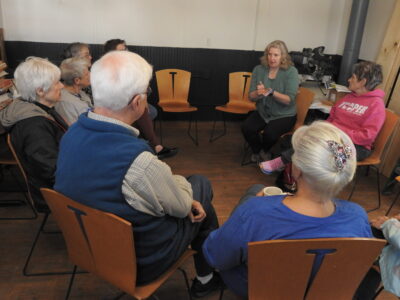
L'ANSE -- State Rep. Jenn Hill addressed issues such as homelessness, internet access and funding in the upcoming state House budget at a meeting with constituents in L'Anse Saturday morning.
Hill, D-Marquette, represents the House's 109th District, which includes Baraga County after 2020's redistricting. The district also includes Marquette and Alger counties, and the eastern two-thirds of Dickinson County.
Hill spoke about the benefits the proposed House budget would have for K-12 schools.
It would fully fund special education costs, filling a gap that had previously been filled by local districts, Hill said. It also includes universal school breakfast and lunch, which Hill said could get rid of the stigma surrounding students getting free meals.
"That's going to take workers, which is a challenge, and increasing the capacity of our communities, but we know we're going to do that," she said.
The proposed budget also includes $300 million for mental health, and another $300 million for early literacy.
The per-pupil foundation amount, which determines how much state aid districts get, will go up 4% next year, Hill said. The gap is being closed with wealthier areas with higher property taxes, which had received higher foundation grants.
A $150 million school transportation fund would help alleviate problems with rural districts. To help get kids back on track after COVID, another $300 million program would fund after-school programs and summer programs.
"It's helping spread the word that there's going to be so much more available in the schools than there ever has before," Hill said.
One resident who had worked with homeless residents for 40 years in Minnesota said the phenomenon was present in the area, but more hidden than in other areas.
Hill agreed homelessness was a "hidden crisis." The primary cause of homelessness is a combination of not having enough housing units and mental health and drug issues, Hill said.
In one instance in Marquette, there were about 40 homeless people living behind the Walmart in Marquette after the homeless shelter filled up during COVID. Churches took them in; zoning regulations then required them to move every two weeks.
Hill favors the "Housing First" approach that has been successful in other places around the country. Hill said the goal would be "permanent supportive housing," which combines long-term housing assistance with supportive services.
There's money for housing in the budget, though there's still some question as to how to get those units built, Hill said.
"I have been talking about this for years, and it's a question of finding the right building and then having the people to offer the services and support to get out of the crisis that they're in and move into a more stable situation," she said.
The state's revenue estimating conference said tax revenue continued to be high enough to allow for tax cuts while still maintaining a balanced budget, Hill said. The House budget includes the repeal of the pension and increasing the working family income tax credit from 6% to 30%.
The House budget also includes a $2-per-hour wage increase for direct care workers in places such as homeless shelters, nursing homes and assisted living care.
"We're losing those folks, we're having all this churn ... it just doesn't pay that well, and it's really hard work, it's emotionally taxing work," she said.
The state will also be accelerating the ability to get a master's in social work, Hill said.
"People who want to work with people who need help are going to have a an easier path to getting that degree," she said.
The state of Michigan roads was also on residents' minds. After Saturday's session, Hill planned to ride around with Baraga County Road Engineer Douglas Mills to see some of the roads with the most pressing problems.
Hill said the current law for road funding will need to be overhauled in the era of electric vehicles. The gas tax provides about 40% of funding for the state transportation fund.
The number of lane miles is one of the main factors under the current law. Another possibility being discussed is paying by vehicle miles traveled.
"Of course that's worse for us, because we all go further distances," she said. "There's going to some workaround, because we've got to have enough money to put the asphalt down and gravel down and pay for the workers. At some point, we're going to have to open that thing open, and everyone's going to be holding their breath and holding their nose."
Hill also addressed another common problem, internet access in remote areas. Federal funding given to expand broadband in the U.P. three years ago went to a Georgia-based company that hasn't added much yet. Hill had spoken with representatives from Peninsula Fiber Network who were frustrated by the slow pace. Local companies aren't able to make upgrades yet because they're waiting for the Georgia company, she said.
Hill said she would be relaying their concerns to Lansing.
In addition to Attorney General Dana Nessel, she would be working with the head of Michigan's high-speed internet office.
"He's an NMU grad," Hill said. "He knows where L'Anse, Michigan is, so we're working with him closely."
Afterwards, she said one of her biggest issues would be finding ways to reduce high energy costs in the U.P.
"I just got named to a state energy task force, and we're getting in there and we're able now to make the changes that I've been talking about on the outside," said Hill, who spent seven years prior to her election working on a nonprofit for renewable energy.
As the only member of the Upper Peninsula representing the Democrats, Hill said she had been making a point of meeting with groups. That had included a town hall with seniors in Marquette last month, and would be rotating through areas in the district in future meetings. Her aide will also be attending meetings in all of the 30-plus townships in the districts.
"I need to listen, I need to have the relationships with folks so that I can go down and make the case for what's going on in the U.P.," she said.
Hill commented briefly on Second Amendment resolutions passed by Baraga County and other boards protesting "red flag" laws and other gun-control legislation in the state. Some resolutions included clauses that indicated the boards would not approve new county funds or resources for the enforcement of laws they felt violated the state or federal constitution.
"I have to uphold the constitution," she said. "That is my job, and I would lose my job if I don't."
Hill also addressed another issue that could affect housing supply: short-term rentals. Marquette set a cap of 250 homes. That status is not permanent; if an owner sells the property, it must go to the back of the waitlist.
Hill opposed proposed legislation that would eliminate municipalities' abilities to regulate short-term rentals.
"Each community is going to decide what's right for them, and that's what I see eventually coming," she said after the meeting. "If we let it be completely unregulated, where are workers going to live? We have to have housing for people who are starting out, and that's the hardest housing to find right now."