Kids are missing school
Rural districts trying to change
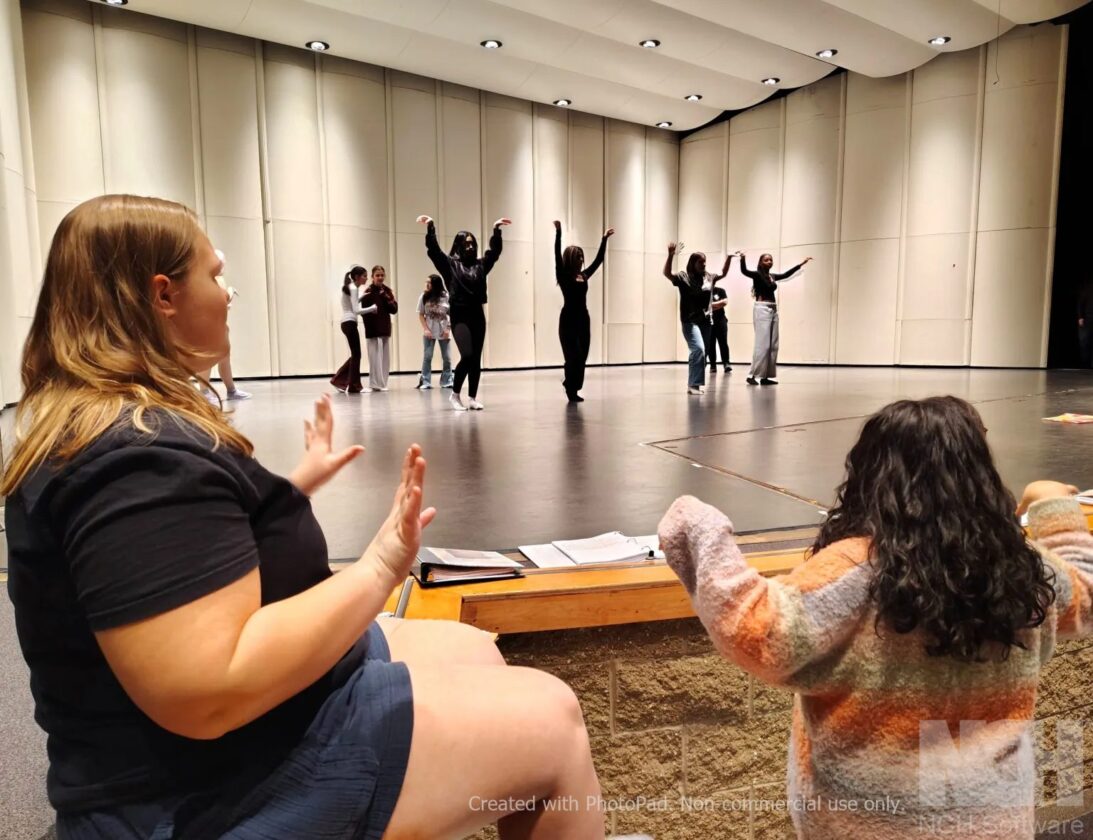
Julie J. Riddle/New/Nuevo Opinion A rehearsal for South Haven High School’s spring musical. School clubs and sports engage students and make them want to show up for class, says Principal Amy Cockburn.
VAN BUREN COUNTY ― A lot of kids are missing a lot of school in parts of rural Southwest Michigan.
School leaders say the issues fueling rural chronic absenteeism, such as inadequate transportation, poverty, and homelessness, are beyond the reach of under resourced districts. And in a struggling part of Van Buren County, high absentee rates have ticked even higher at several schools in recent years.
But several new administrators believe their efforts will turn those numbers around ― and they’re using tactics a researcher says are likely to work.
And not a moment too soon, says Amy Cockburn, recently installed as principal at South Haven High School after many years as a teacher and administrator in rural Indiana schools. Schools in that state have rebounded more quickly from COVID-19 pandemic-driven absenteeism surges than in Michigan, possibly because of new, tougher laws. Absent those laws, it’s up to schools to dig in and fight to bring students back. “We can put a lot of blame on things, but that doesn’t do any good,” Cockburn says. “It’s, stop making excuses and what are we going to do?”
Doing what works
About 26% of Southwest Michigan students were reported chronically absent last school year, missing at least 10% of school days. That’s slightly better than the state’s 28% of students reported chronically absent.
Southwest Michigan absenteeism percentages range from 7% at Berrien Springs Public Schools to 68% at Benton Harbor Area Schools. Very rural districts report some of the highest absenteeism rates, including 39.5% at Bloomingdale Public Schools and 41.8% at Bangor Public Schools, both in Van Buren County.
Schools need to use the right tools to bring those numbers down, says absenteeism researcher Jeremy Singer, an assistant professor at the University of Michigan-Flint. Most schools have ramped up efforts to curb absenteeism in recent years, according to a report released in August by Singer and fellow researcher Sarah Winchell Lenhoff based on a survey of Michigan school administrators.
But many schools fail to do what actually works to get kids back in school, Singer found. Common, low-cost strategies like robocalls and letters home “might move the needle a little bit, but they’re not going to solve the whole problem,” Singer says. Higher-impact, less common approaches like home visits or transportation assistance require more resources than many schools have available.
Efforts to make kids want to come to school are least common, even though, Singer says, such efforts are the most promising practices within schools’ control. “You don’t have to have a million new initiatives,” Singer says. He recommends a rational combination of strategies that develop relationships with families and focus on school climate and culture. That could include phone calls home, helping parents make attendance plans, and communicating about the importance of good attendance to fight the problem before it happens.
Of course, schools can’t solve the biggest attendance problems alone, Singer says. Communities have to pitch in by addressing the big issues that impact students’ ability to get to school.
Pullman Elementary School, part of the sprawling Bloomingdale Public Schools district, sits seven minutes north of the Van Buren/Allegan County line. Trailer homes patched with plywood and plastic sheeting line the local roads. In a region with scarce jobs and no public transportation, families without adequate income often double up in those cramped trailer homes, including some of the district’s 87 students who were homeless last year, says Rick Reo, district superintendent since the fall of 2024. Even the best-intentioned parents struggle to get their kids to school in such circumstances, Rio says.
About 44% of the school’s students were chronically absent in 2024-25. Sickness accounts for some of those absences, exacerbated by a lack of easy access to medical care. More often, kids simply miss the bus and no parent can drive them.
School admins have sent empty buses to pick up kids who missed the first one, but “that can get expensive,” Rio acknowledges. Gas cards for parents and a van sent to pick up unhoused students temporarily outside bussing boundaries don’t help enough, either.
Rio hopes a revived focus on attendance will bring absenteeism numbers down. The district celebrates attendance and academic success with parent/student breakfasts and assemblies. The middle/high school in Bloomingdale recently started running a 5:45 p.m. bus, enabling students to stay late for tutoring, clubs, and sports. That means more connected kids ― and more kids that have a reason to come back to school the next day, Rio says.
“I don’t think anyone’s figured out the attendance problem,” he acknowledges. “Is there more we can do? Absolutely.”
The community, though small, provides Pullman Pride scholarships and is working on a grant to create safer pathways to school for kids who can’t get a ride. He’d like to get local volunteers into classrooms to wrap students in even more support.m”We have to do everything we can to make this place a place the kids want to be,” Rio says. After all, “if kids aren’t here, how can they learn?”
At 42%, Bangor Public Schools reported the highest absenteeism percentage among rural school districts in Southwest Michigan last year. That has to change, new Bangor High School principal Tammy Wilson says.
Some high schoolers miss school because they have been “parentified,” kept home to look after younger siblings while a parent works. Others hold down jobs to help support the family. Others “just don’t want to be here,” she says. “They aren’t looking to the future and thinking of, ‘What could I do, where could I go, who could I be?'” she says. “They’re just trying to survive.”
Since assuming her post last spring, Wilson has tried to boost the school’s focus on absenteeism, including by personally visiting homes of students at risk of court intervention because of absences. She uses resources from an online attendance promotion site, such as the daily attendance announcements Marbut makes over the loudspeaker.
“Running late? Still come in. Minutes matter more than excuses,” Marbut announces on a “Take-charge Tuesday.” Some students tell her the announcements are cheesy, Marbut says. She sees that as a win. “The thing is that they’re hearing it and noticing it.”
School connections are crucial, Wilson says. She and the office staff greet students by name. To promote student involvement, she changed the homecoming schedule so decorating and other activities happen during the school day. She creates “guess the teacher” games and plays music in the hallways on Fridays.
“We’re trying to change the culture to, ‘I want to be here,'” Wilson says.
At nearby Covert Public Schools, absenteeism numbers are still high but moving in the right direction, decreasing from 41% to 35% last school year. A new focus on reinforcing positive student behavior has helped change the school culture, giving students more reason to want to be there, says Christine Strayer, middle and high school principal for the district.
High school admins recently toughened policies to require greater attendance for course credit. At the same time, they’ve adopted a credit recovery program for students with learning needs, allowing students to complete some of their instruction hours remotely. That program has only been in place since October but shows promise, Strayer says.
Many of Covert’s students experience a significant degree of trauma in their home lives ― substance addiction, food insecurity, mental health issues, poverty ― and have few resources to help them. The district serves many students with learning disabilities and many without stable housing. And the town offers little for kids to do: “We’ve got a single library, and that’s it,” Strayer says.
Rural schools, even those with limited resources, are often the hub of their town and try to meet as many needs as they can. But “It’s hard to love them when they’re not here,” Strayer says.
She believes attendance numbers will continue to improve, thanks to the love and passion of school staff for their students. “We pour everything into them,” Strayer says. “And we hope that’s enough to keep them coming back.”
South Haven High recently converted one staff role to focus full-time on curbing absenteeism. The school is considering offering virtual health clinics for students, which could mean fewer missed days to visit specialists in other towns. A school nurse could offer the same benefits, but, Cockburn says, that’s a luxury many small schools can’t offer.
The school seeks ways to make at-risk students feel needed, like asking them to read to younger children. A school therapist meets with small groups to help students identify their skills and build the belief that “school’s not actually that bad because I’m good at this.”
Fixing absenteeism takes all of it, all the data-proven methods, enacted together and “done with fidelity,” Cockburn says. And there’s no quick fix. As the school, and the region, work to fight bulging absenteeism numbers, those numbers might go the wrong way for a while, she acknowledges.
“Sometimes when you turn the heat up it gets a little bit worse before it gets better,” Cockburn admits. “But do I have hope? Absolutely.”
“This story was originally published by Bridge Michigan, a nonprofit and nonpartisan news organization. Visit the newsroom online: bridgemi.com.”
Michigan News
Illegal alien sentenced in Michigan Federal Court
GRAND RAPIDS, MICHIGAN – U.S. Attorney for the Western District of Michigan Timothy VerHey announced Tuesday that ...
Taking precaution

Kids are missing school
Regulating cell phone use

One-buck rule