
Protecting the Keweenaw from invasive species
Early detection is key
Trending
HOUGHTON -- Each spring in the Keweenaw, we patiently await the return of green forests, open water, and long days outside. Earth Day is a reminder of just how much we value these places, and how important it is to protect them. One of the most effective ways we have to do that is Early Detection and Rapid Response (EDRR).
EDRR involves finding newly detected invasive species early and acting quickly before they spread. Even with strong prevention efforts, some invasive species still slip through. When they do, timing matters. Identifying a population while it is still small gives us the best chance to remove it completely and avoid long-term ecological and economic damage.
Why early detection matters
Invasive species are non-native organisms that can harm the environment, economy, or even human health (https://www.michigan.gov/invasives). Once established, they can be extremely difficult--and expensive--to manage. That's why EDRR is considered one of the most cost-effective strategies for invasive species management (https://www.invasivespeciesinfo.gov/subject/early-detection-and-rapid-response).
How does EDRR work?
EDRR is a coordinated effort involving agencies, local organizations, and the public. In Michigan, that includes groups like the Michigan Department of Natural Resources (MIDNR), the Midwest Invasive Species Information Network (MISIN), Cooperative Invasive Species Management Areas (CISMAs), and regional partnerships like the Woody Invasives of the Great Lakes (WIGL). Locally, the Keweenaw Invasive Species Management Area (KISMA) coordinates efforts across Houghton, Keweenaw, and Baraga counties.
It starts with detection: Someone notices a plant, insect, or organism that seems out of place. This observer could be anyone, even you! Next, experts verify the identity of the species and teams assess how widespread it is and whether it can be contained or eradicated. If so, response crews move quickly to remove or control the species before it spreads further (https://www.doi.gov/invasivespecies/early-detection-and-rapid-response).
Public reporting plays a huge role. Tools like the MISIN smartphone app or MISIN Verification Network allow anyone to submit sightings, often with photos and GPS locations, helping experts respond faster.
What is the Michigan Watch List?
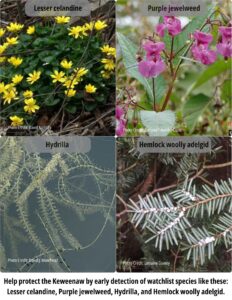
The MIDNR Watch List focuses on species that are either not yet established in Michigan or only found in a few locations. These are exactly the species where EDRR can make the biggest difference (https://www.michigan.gov/invasives/id-report/watchlist). Because these species are still rare, even a single report can trigger a rapid response effort that prevents them from becoming widespread. Examples of some watch list species are listed below:
● Lesser celandine (Ficaria verna): Invasive spring ephemeral plant that outcompetes native spring ephemeral wildflowers, decreasing habitat and reducing diversity. (See related article below)
● Purple jewelweed (Impatiens glandulifera): Herbaceous annual plant that can alter water flow, increasing risk of erosion and flooding.
● Hydrilla (Hydrilla verticillata): Aggressive aquatic plant that impedes irrigation and boating.
● Hemlock woolly adelgid (HWA): A tiny insect that can kill eastern hemlock trees, which are a key part of many U.P. forests.
Organizations like WIGL also track a broader set of high-risk woody invasive plants across the Great Lakes region to help guide early detection efforts. Additionally, some species like oak wilt and European frog-bit, while present outside of Baraga and Houghton Counties, require vigilance to prevent their spread, given their proximity.
This article was written by Paul Bramstedt (Michigan Technological University undergraduate student), Troy Tofil (Assistant Coordinator of the Keweenaw Invasive Species Management Area (KISMA)), and Dr. Sigrid Resh (Coordinator of KISMA, College of Forest Resources and Environmental Science, Michigan Technological University, kisma.up@gmail.com)