Crowd marches for free, fair elections
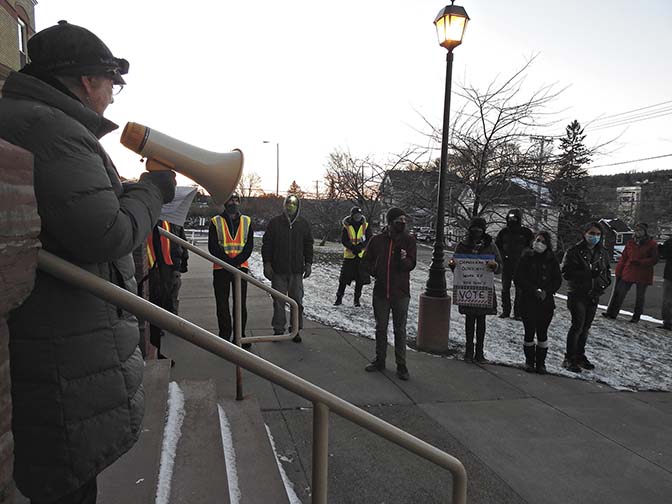
Garrett Neese/Daily Mining Gazette Barry Fink, president of League of Women Voters of the Copper Country, speaks to a crowd of about 20 during the Every Vote Counts Vigil for Democracy at the Houghton County Courthouse Sunday.
HOUGHTON — About 20 Copper Country residents marched to the Houghton County Courthouse Sunday night for a vigil in defense of free and fair elections.
The Every Vote Counts Vigil for Democracy was put on by the Keweenaw chapter of We Make Michigan, a coalition of grassroots organizations, communities and congregations demanding every vote be counted. The organization is holding similar events statewide before and after Election Day in spots such as Lansing, Traverse City and Munising.
Signs about candidates or parties were not allowed. Instead, marchers carried signs like “Democracy does not work if you don’t vote.”
With some wearing head lamps or carrying electric lights, the group walked from the Grace Methodist Church to the courthouse, where several speakers talked about the importance of voting.
The level of excitement on the Michigan Technological University campus for this election is unprecedented, said Zachary Olson, the chairman of political affairs for Tech’s Undergraduate Student Government.
Olson helped organize a voter registration drive on campus in September. Many students had requested an absentee ballot by the end of that month, and countless more had cast absentee or early in-person ballots in the month since, he said.
The coming election might be one of the “most extensively litigated and hotly contested” in the nation’s history, said Olson, who was also recently named a fellow of the Campus Engagement Election Project, a national nonpartisan program that works with college campus across the country to encourage participating in elections at all levels. He called on people to reject any attempts to call the election prematurely or interfere with the results.
“No matter who the winner is, and whether the outcome is clear or dubious, we must follow through with this commitment and continue to work to give everyone a voice in government, including the young, the oppressed and the powerless,” he said. “The short term goal is to make sure every vote is counted in 2020. But the long term goal is to create a democracy that is truly a representative democracy.”
Who gets to vote has been an ongoing question in America, said Barry Fink, president of League of Women Voters of the Copper Country. At the country’s start, the franchise was restricted to white males who held a certain amount of property. Post-Civil War amendments extended the vote to Black males. Women got the right to vote in 1920; Native Americans did not receive the right to vote until four years later. In 1952, the vote was also finally extended to immigrants of Asian descent.
Progress has not been linear. Within a few years of Black men getting the vote, those gains on paper were hollowed out on multiple fronts: legally through Jim Crow laws and illegally (though rarely treated as such) through lynching.
It took the 1965 Voting Rights Act to fully enshrine those rights for Black people and other minorities, Fink said. But some of those protections were dismantled through the Supreme Court’s 2013 ruling in Shelby County v. Holder. That ruling ended the requirement for jurisdictions with a history of voting rights violations to pre-clear any changes in election law with the federal government.
“In recent years, in dozens of states, many strategies have created intentional barriers to the right to vote,” Fink said. “Thousands of citizens are up against those as we speak. Some people believe our votes do not matter … I would simply say, if voting does not matter, why do we have nearly 250 years of struggle over the question of who gets to vote?”
Fink also recognized those involved in making sure elections are conducted fairly, from clerks to identified poll watchers from parties who ensure votes are cast and counted. (Fink stressed “identified.”)
“Also, part of the voting process is the creation of a welcoming environment for voting,” she said. “A welcoming environment is free of electioneering, free of intimidation, and any actions that make a prospective voter feel unwelcome to exercise their fundamental right to vote.”
Bucky Beach, reverend at Good Shepherd Lutheran Church in Houghton, said believing that every voice counts, and enabling it to speak, means accepting different opinions. That can be challenging, but it’s what brought the crowd together Sunday, he said.
“Every vote is a voice and every vote matters because every person matters,” he said. “People who believe as we do have a responsibility to be proactive rather than reactive. And that’s important to remember right now because we may be in for a very long season, as we heard before. So remember, composure, and equanimity, and not passivity. We stand together more in what we are for, not necessarily what we are against.”
Front Page
Public Safety Day recognizes 10th anniversary
Heart of copper made gold

Warm start to summer favored for UP region
SWP to fund planting of 100,000 trees in Marquette County
MARQUETTE — The Superior Watershed Partnership and the Land Conservancy has announced the launch of its Great ...
Miscowaubik Club to host open house