Houghton council OKs pursuing bond, grant for Lakeshore deck site work
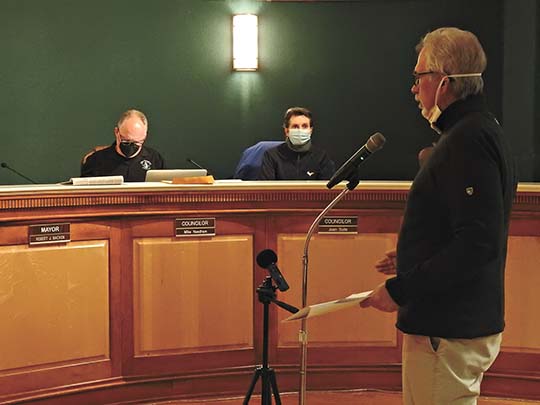
Garrett Neese/Daily Mining Gazette Urban planner Pat Coleman gives a final report on public sessions on the Lakeshore Drive deck site during Wednesday’s Houghton City Council meeting.
HOUGHTON — Houghton is pursuing paths that could provide funds for both the teardown of the Lakeshore Drive parking deck and the start of what comes next.
Wednesday, the city council unanimously directed city administration to start the process of a $1 million bond to cover the teardown of the parking deck and make minimal repairs to the surface parking. The city would then also apply for a Michigan Economic Development Corp. Revitalization and placemaking grant, which would allow it to leverage the bonded work to make streetscape improvements on Lakeshore Drive and bring in an engineer to develop plans for the demolition and a streetscape project.
The council voted last year to begin parallel processes for tearing down the deck and starting the process for replacing it.
Urban planner Pat Coleman also presented his report Wednesday from two public sessions held last fall asking the public what should be put up in place of the deck. The most popular option was some kind of mixed-use development, combined with a more efficient parking structure.
“Housing is a real need, not just in Houghton, but nationwide,” he said. “So this site really offers a great opportunity to create some housing on upper floors, perhaps some retail on the ground floor.”
Other concerns included improving walkability and helping grow business at new and existing locations along Lakeshore Drive, Coleman said.
Teardown of the deck would take about two months, costing about $750,000, City Manager Eric Waara said. It would cost about $250,000 to do minimal restoration of the surface parking.
The city will have to pay for the demolition work upfront, Waara said.
He proposed a $1 million bond. Over 10 years, it would mean $130,000 annual payments; if spread over 15 years, it would be $90,000.
To finance the bond payments, the city could sell some of the Lakeshore Drive property for redevelopment. That could raise between $400,000 to $600,000, Waara said. Once developed, that would result in more tax revenues for the city, Waara said.
“There’s time to work through what piece that is — is it a big piece? Is it a little piece?” he said. “Is it on this end or that end? We’ve got the time to do that, so we can work up what would look like an acceptable development plan. MEDC, through Redevelopment Ready, can help us get there.”
If not the Lakeshore site, the city could potentially sell off another area. In addition to tax revenue from the site, the city would obtain tax revenue and potentially fill in community needs such as housing or retail, Waara said.
“We’re not talking about selling off our parks or anything like that,” he said. “But there’s other pieces of property the city owns that we could sell for redevelopment and possibly fill some of those needs in the community.”
Any sale could take time to develop. Waara suggested holding some of the city’s Federal Emergency Management Agency reimbursements for bond payments.
The bond investments could then also be leveraged into streetscape improvements. The Michigan Economic Development Corp. announced a new Revitalization and Placemaking grant, with applications due this spring. The 50% grants would provide up to $1 million for public space improvements. More money would be available from the MEDC with private investment, Waara said.
Waara presented a rough concept for Lakeshore Drive that he said could turn the site into the “gateway to the waterfront,” strengthen its connections to Shelden Avenue and set up buildings along the street for other uses in the future. It would include four-season walkable connections from Lakeshore Drive to Shelden Avenue — one by the 5th & Elm building and another further west near The Print Shop and Joey’s. The estimated cost would be $900,000 to $1.2 million.
“We would maximize the parking for the time being, but would allow for other uses in the future, and it sets the stage for those buildings that are fronting or backing on the deck right now, for those uses to be reimagined and realize new opportunities,” Waara said.
Waara said there would be more future input sessions from the public. Being a redevelopment-ready community also opens up the city to more professional development from the MEDC.
In a best-case scenario, the city could begin tearing down the deck this fall, Waara said. More likely, it will be sometime in spring 2023.
“We certainly don’t want to do it in July, we certainly don’t want to do it move-in weekend for Michigan Tech,” he said.
Front Page

Still undecided

Down on the farm

St. Ignace teen arrested
Motorcycle fatality in Dickinson County
BREITUNG TOWNSHIP — A 21-year-old Niagara, Wis., man was killed Thursday when the motorcycle he was operating ...
Sure sign of summer