The instrumental soloist
The moment had arrived. I began playing the introduction and there were smiles all around the choir loft. They had asked for this song. It was their favorite.
Christmas Eve. The Midnight Service.
The town looked like a Currier and Ives painting. This was the Upper Peninsula at its winter best.
The wind blew the snow around like a white dust bowl. Visibility was almost zero. Cars, their lights barely visible, slowly passed the church like ghosts on parade.
The parking lot filled quickly and the remaining cars tried to find a place along the curbs, buried under several feet of snow. The occupants quickly walked to the side door of the church where they could enter the undercroft, the lower level of the church, where they could shake off the snow, stamp their feet on the floor’s rug where it then quickly melted, leaving little puddles on the linoleum in the entry way. Coats and hats were hung in the cloak room; and then slowly up the creaky stairs where they ascended to the sanctuary.
The church looked so festive and so joyful! The tree, the garlands and the candles had all lovingly been placed by the decorating committee. It looked the same each year.
Change is hard to come by in the century old church. Newcomers greeted those who were already seated, and then they too quickly found their seats. The service was almost ready to begin.
The organ, the only three keyboard organ in the entire area, was my domain. Shortly after arriving in Houghton/Hancock in Michigan’s Upper Peninsula, the Episcopal Priest, Father Gerdau, came to see me in my school office. I was the newly hired Music Professor for what was then called Suomi (Finland) College; now known as Finlandia University. It was a two-year Finish Lutheran College that at one time even supported a seminary.
Father Gerdau was a big man; well over six feet tall, with a character that was somewhat overwhelming.
He was not one to waste time on small talk, and to say that he was “direct and somewhat loud” was probably an understatement. He said in his somewhat booming voice, “Garrett!” (For some reason he never called me “Gerrit” in all the years that I served him and Trinity Episcopal Church. I toyed with the idea of responding to him by saying, “Yes, Master!”, but thought better of it. Somehow I knew that he meant well and I just learned to be “Garret.”
He said, “Trinity needs a good organist, and I have already checked you out, and I know you will fill the bill beautifully.” (I found out later that he had checked quite extensively.)
“Here is a list of the requirements and on the bottom is the salary that we have set aside for the position for a man with your talent. Let’s go look at the church so that you can see the organ and then I’ll take you out for lunch and we will seal the deal.”
I was slightly overwhelmed, but I instantly liked the man’s approach. It was pretty direct, and I value that in an employer. We drove to Houghton’s Trinity Church, right on U.S. Highway 141. I immediately knew that this was for me.
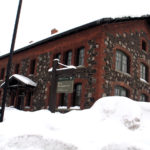
The church was over a hundred years old, and it looked very Episcolpal! The organ was a lovely three manual Austin Pipe Organ (the largest pipe organ in the U.P). It needed a little work, but overall it sounded beautiful and seemed to be in relatively good shape.
I was sold.
Father Gerdau then took me out for a lovely lunch. Everyone seemed to know “father.” During lunch I quizzed him about the position and he quizzed me about me. By the time lunch ended we were sold on each other and we began a bond that lasted for the remainder of my U.P. years.
I learned that the congregation and the choir were small, but very loyal. They had been without a musical leader for some time, and Father told me “You’ll be welcomed with open arms.”
I found out he was right. Literally! I had found my spiritual home and a place where I could “preach from the organ bench.”
For the Christmas Eve Prelude, I had selected variations on Christmas Carols by some of my favorite Dutch composers. A short pause and then it was time for the opening processional carol, “O Come all ye Faithful.”
The congregation knew that it was their turn, and together, as drawn by a heavenly string, they rose to their feet and they began to sing the invitational words, “O Come, all ye Faithful.”
The sound filled the church. They sang as if they wanted to be sure that their song would touch the heavens, so that He, whose birth we heralded, would hear and be pleased.
As the congregation sang, the choir, in their newly dry-cleaned robes, processed down the aisle. They paused briefly in true Episcopal Church style by the altar rail. They bowed slightly and then entered the choir pews on both sides of the chancel.
You could tell that they were so proud of themselves. Everything was going beautifully. Father Gerdau, with the help of the acolytes, began the liturgy. The words of the ancient story never sounded more beautiful; “Unto you is born this night, a Savior, who is Christ, the Lord.”
It was time for our first Anthem, “Do you Hear What I Hear?”
It was one of many carols in this special service. The song had been requested by the choir. It was their favorite. It was almost a “pop” Christmas song, but I was happy to honor their request. It told the Christmas story in an endearing, child-like way.
The simple music had been ordered and we had learned it well. In addition to the organ accompaniment there was also a part for finger cymbals. (Finger cymbals are a miniature version of the large cymbals played by percussionists in an orchestra.) One cymbal is attached to the thumb and the other to the index finger. The idea is to strike them together quickly and with a certain amount of force so that they can be heard.
Mary, one of the older choir members, volunteered to play the cymbals because many years ago, she had played them in her high school glee club. Mary was a jolly person whose laugh would fill whatever room she occupied.
I gladly gave her the cymbals and as we rehearsed she played them with class. I called her my “Instrumental Soloist” and listed her name in the bulletin as such. She was so proud.
She intently followed the music and watched me for her queues. Each time, when it was her turn, she came in at the right time and her big smile told everyone how she felt. By Christmas Eve, everyone in the congregation knew that Mary would be playing the ‘Instrumental” part in “Do you Hear.”
I signaled the choir to stand and began the introduction, “Pum, papapa, pum, pum, pum.”
I queued Mary. Nothing. There was no cymbal sound.
I continued playing and the choir started to sing, but they were obviously startled. What was the problem with Mary? I looked over to where she was standing.
She was concentrating so hard.
The tip of her tongue stuck out from between her teeth, and her entire concentration and energy was directed at her fingers. Each time she brought her index finger cymbal down to her thumb cymbal, she somehow failed to make contact. They passed by each other silently, like two ships in the night. By now everyone was looking at Mary. The more we looked the harder she tried, but to no avail.
Finally, thankfully, the song ended, and the choir sat down. Mary tried to connect one more time but it was of no use. Her moment had come and gone. The rest of the service went reasonably well, but Mary was visibly shaken. One of the choir members whispered to her and started to giggle. She gave me a “thumbs up” sign, to let me know that whatever Mary’s problem was, it was not physical or life threatening.
After the service I learned that two glasses of wine were the reason for Mary’s “problem”. During an early Christmas Eve dinner Mary had had a little too much of the bubbly and her coordination paid the price.
She told me later how sorry she was for what had happened. I assured her that God does have a sense of humor and that I am sure He recognized her effort, and perhaps shared her story with the angels. Somehow I have this vision that when Mary entered through the pearly gates a whole chorus of angels, all with finger cymbals, welcomed the “Instrumental Soloist” from Houghton, Michigan.
EDITOR’S NOTE: Gerrit Lamain is a former Copper Country resident who served as a music professor at Suomi College. He has published a book, “Gerrit’s Notes: A compilation of essays,” which can be found on Amazon. His email address is gerrit.lamain@gmail.com.
Local News
In Brief: Wednesday
Keweenaw County Board meeting tonight EAGLE RIVER — The Keweenaw County Board of Commissioners regular May ...

Big Brothers Big Sisters honored
Setting it straight
Regarding an article in April 22, Daily Mining Gazette entitled "Help Wanted," the date for this year's Pitch in ...
In brief
Range Lions Club gives back SOUTH RANGE — At its April meeting, the Range Lions Club continued its tradition of ...
In brief
Garden Giveaway HOUGHTON–In honor of Houghton's effort to become the first Bird City in the Upper Peninsula, the ...