
F1 Review: Back where it all began
Trending
ENGLAND -- As people in the United States celebrated with fireworks and cookouts over the Fourth of July weekend, Formula One (F1) teams were hard at work near Milton Keynes, England, putting on the British Grand Prix, the ninth race of the season. Much as the 4th is a time to look back on the beginnings of the United States, returning to the Silverstone track is a trip back to where F1 racing began in 1950.
Nearly as long as there have been automobiles, people have raced them. F1 can trace its roots back to the 1920s and there is some contention on what should be considered the first truly international F1 race, but the May 13, 1950 race at Silverstone was the first under the official World Championship for Drivers format which they still follow today.
As the weekend of racing got underway, it also seemed like the season was going back to where it started with Mercedes dominance. Lewis Hamilton managed to get his Ferrari onto pole position for the sprint race, but Antonelli stayed with him and passed him for the lead, driving off into the distance and winning by nearly three seconds.
Though Antonelli excelled in the sprint race, his teammate George Russell struggled comparatively, only qualifying fifth and finishing fourth. While there are only 8 points on offer for the win in a Sprint race compared to 25 in the feature race, this still allowed Antonelli to increase his lead by another three points over his teammate and closest rival. Another event harkening back to the beginning of the season was the start from the McLaren duo, Lando Norris and Oscar Piastri, who started in sixth and seventh place respectively. They both bolted off the grid when the lights extinguished, Norris comfortably in third and Piastri fighting Russell for fourth. In the next corner, Norris moved up to second place and Piastri pipped Russell.
Early in the season, the Ferrari duo had the best launch, but the McLaren cars were pretty quick as well. The other teams fixed the majority of their issues with their starts, and everyone was mostly on equal footing in the last couple of races. Why did McLaren get the jump on everyone this time?
The answer was in their energy deployment. McLaren decided they would pour everything they had into the opening few corners and push forward as much as possible, hoping to defend track position once they gained the places. As the field drove onto the first long straight, it became clear the McLaren cars had nothing left to fight back with energy-wise and were quickly swarmed by the drivers they had just overtaken.
While passed by both Mercedes cars, Norris managed to repass Russell and kept third place at the end of the race. Piastri, on the other hand, quickly sank right back to seventh and was mired there throughout. The frenetic pace of the opening lap has become something of a mainstay in this year's racing and I've found it to be quite exciting. Others don't care for the pass/repass mechanics these cars have, but the dueling methods of energy deployment is just another piece in the puzzle of F1 that I find fascinating.
Saturday afternoon, the cars were back on the track for the feature race qualifying, and Ferrari showed Hamilton's pole position in the sprint race was no fluke as Charles Leclerc lined up in second with teammate Hamilton in third. Antonelli managed to get back on pole, and his teammate Russell was in fourth.
The excitement at the start of the feature race came in the form of the two Ferrari cars leapfrogging Antonelli. Leclerc led early on with Hamilton in second place. In a reverse from the sprint race, Leclerc seemed to figure out his Ferrari while Hamilton struggled to match the pace of his teammate. Soon enough, Antonelli was able to pass Hamilton and set off after Leclerc. Hamilton battled with Russell and Verstappen for third for much of the race.
The plan was for most cars to do a single pit stop in the race, going from the medium tires they started on to the hard tires to finish the race. Leclerc came in on lap 25 (out of 52) to switch to his hard tires. Antonelli assumed the lead at this point and stayed out until lap 35, much later than Leclerc, who he was fighting for the lead, and his Mercedes teammate Russell who pitted on lap 23.
Antonelli emerged from his pit stop seven seconds behind Leclerc. With newer tires on his car, he could keep up a faster pace. Soon, Leclerc had only a three second buffer to Antonelli, and it looked like there would be several laps for the two to fight for the win.
We were denied that excitement, however, when Antonelli suddenly suffered with a problem. He was off the track in several corners, unable to get his car to turn in correctly. Despite having more than 300 sensors transmitting more than 1.1 million points of data per second back to the team, no one at Mercedes could figure out what was wrong with Antonelli's car.
Russell had a slow puncture in one of his rear tires, forcing him to make a second pit stop on lap 34. Mercedes was worried something like that could be happening to Antonelli, but the data didn't support it. Still, Antonelli came in on lap 41 for a pit stop where they changed his tires and gave him a new front wing. Heading back on track, Antonelli reported he was still having troubles and went off track a couple more times, losing time and track position.
On lap 43, Antonelli pitted again after the team finally visually saw what was wrong with his car. The front-left wheel shield and part of the brake duct broke when Antonelli went over a curb, and his mechanics ripped the component away during the stop. Shockingly, after two pits stops and three laps of troubled driving, Antonelli was in tenth position which is worth one point at the end of the race.
Fully aware that last year's driver's championship was decided by a mere two points, he knows every point is critical, even in a long season. His race engineer came on the radio, telling Antonelli he was dinged for several track limit violations while dealing with his ailing car. A 5-second penalty was inevitable despite the fact these off-track excursions cost Antonelli time and were the result of an ailing car, not his efforts to drive more quickly or get any kind of advantage.
"I can try. I can try to get the point. At least one point," Antonelli replied.
Once he had a handle on the car's issues, Antonelli was actually pulling away from Franco Colapinto's Alpine in 11th place with a lead that was nearing four seconds. With a few more laps, he should've been able to get more than five seconds ahead, nullifying his penalty, and still giving him the final point.
Verstappen lost control of his car on lap 47, careening into the gravel trap where his car got stuck, leading to a safety car. This bunched up the entire field, putting all the cars nose-to-tail.
Antonelli gained a position with Verstappen out of the race, but his lead vanished and with only four more laps in the race, he knew he couldn't get a five-second lead again and was doomed to fall out of the points. Ultimately, the race was unable to go back to green flag racing and with his 5-second penalty, Antonelli plummeted to fifteenth, well out of the points.
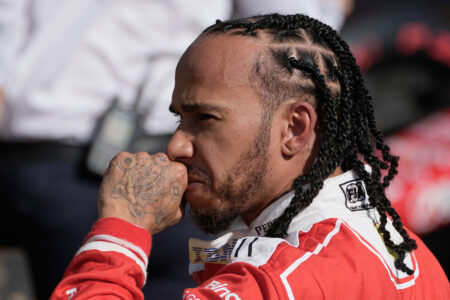
In the end, Leclerc won his first race since 2024, Russell got a much needed second place to close the gap to Antonelli by another 15 points, and Hamilton managed to keep his third-place podium finish. This was Russell's first home podium, and Hamilton's sixteenth in a shockingly stellar record in his home grand prix (he also has nine wins at Silverstone, the most any driver has at any individual circuit in F1 history, and all of this is over just 19 appearances).
Antonelli is still leading the championship, but the lead is down to just 25 points, the reward for a race win. Hamilton is just another seven points back, and Leclerc became the fourth driver this year to get over 100 total points after his win. With thirteen races still to go, the championship is wide open.
What impressed me most was Antonelli's persistence and refusal to give up despite his ailing car. Many drivers would've just pitted to retire the car with the issues and only one point on offer, but Antonelli showed he has his eyes firmly on the championship. This interaction has sold me on Antonelli's bid for the championship even more than his five race wins in a row.
To see if Antonelli can get back to his dominating race performances, tune in on Sunday, July 19, at 9 a.m. Eastern for the Belgium race.