Scaling back Juneteenth
State universities respond to anti-DEI orders
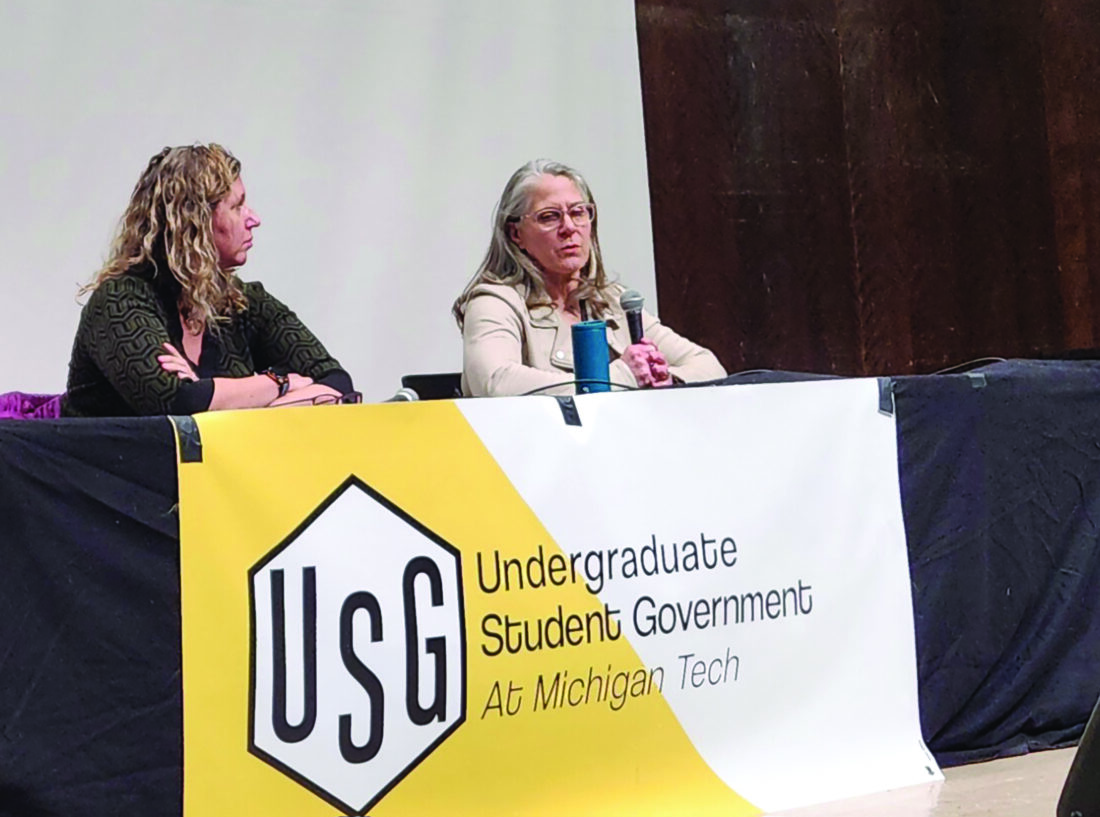
Mary Stevens/Daily Mining Gazette Kelly Raffaelli and Laura Bulleit answer questions from Michigan Tech students regarding changes brought on by President Trump’s executive orders at a public forum earlier this year.
LANSING — Amid the first actions of his second term, President Donald Trump took aim at campuses across the nation, signing executive orders banning diversity, equity and inclusion efforts and federal funding of programs.
The order put some universities on their heels, with Michigan State University abruptly canceling a Lunar New Year celebration due to the executive orders, later rescheduling the event following backlash from students.
In the months since, the administration has issued a “Dear Colleague” letter providing educational institutions from pre-schools to universities with a Feb. 28 deadline to dispense with their diversity programs at risk of losing federal funding, arguing that these programs are discriminatory.
Many colleges ignored the president’s demands, with the President of Western Michigan University instructing the campus to “please proceed as usual” according to a report from the Associated Press.
In service of this decree, the United States Department of Education launched investigations into several universities across the country over race-based programming, opening investigations into Grand Valley State University and the University of Michigan on March 14.
Less than two weeks later, the University of Michigan announced it would shutter its Office of Diversity, Equity and Inclusion and Office for Health Equity and Inclusion, while halting its DEI 2.0 Strategic Plan.
Juneteenth, celebrated annually on June 19, commemorates the date in 1865 when union troops arrived in Galveston Bay, Texas and announced more than 250,000 enslaved Black people were free by executive decree. While the Emancipation Proclamation had taken effect more than two and half years prior, the order was not implemented in several places under Confederate control.
Juneteenth has been a federal holiday since 2021, and was celebrated in Michigan as an official state holiday for the first time in 2024. Although many state universities held panel discussions, showed documentaries, held workshops and spotlighted Black-owned businesses, there was a noticeable pull back among some universities this year, who either downsized from previous celebrations, or opted against celebrations entirely.
While Northern Michigan University led festivities for the first time, and scheduled celebrations at Michigan State University, Wayne State University, Central Michigan University, Eastern Michigan University and Grand Valley State University looked similar to – or built upon – prior events, the University of Michigan’s celebration was notably smaller this year.
In years past, the University’s Office of Academic Multicultural Initiatives held a multi-day “Juneteenth Symposium” which included panel discussions, artistic performances and a Juneteenth Block Party in 2024. This year’s event was instead hosted by the University of Michigan Detroit Center, and featured two speakers focused on community resilience and local advocacy.
Juneteenth celebrations at Western Michigan University have looked different year to year, with the Black Graduate Student Association co-hosting events in 2021 leading up to, on and following the holiday. In 2022, the association hosted a Juneteenth Gala, while the university’s Merze Tate College hosted a Juneteenth cookout in 2023 and 2024.
However in 2025, no events were listed on the university calendar. In a June 17 email, Paula Davis, Western Michigan’s associate vice president for strategic communications, said she did not know if the university was hosting any events. In a follow up email on June 20, Davis said as far as she knew, no events had been held or were planned.
Michigan Technological University leadership in April discussed a number of policy changes brought on by the executive orders, including phasing out the Center for Diversity and Inclusion and moving its staff to new roles at the Center for Student Support and Mentorship. Vice President of Student Affairs Laura Bulleit assured panel attendees that Martin Luther King Jr. Day and Juneteenth celebrations will still take place as long as they remain federal holidays. While the university held events commemorating Juneteenth in 2023 and 2024, none were listed on the university’s event calendar for this year. University communications did not respond to multiple emails asking whether the university had any celebrations planned.
Paulette Granberry Russell, president of the National Association of Diversity Officers in Higher Education said their members had seen a “troubling” trend of institutions scaling back or entirely eliminating academic or social support programs, including celebratory events.
As far as why universities are scaling back, Granberry Russell referenced the demonization of the DEI acronym by conservatives and pointed to comments Trump made on Juneteenth where he declared in a post to his social media site that the nation has “too many non-working holidays.”
“Why choose Juneteenth, you know? And we’ll see if, if there’s something akin to that, if the Fourth of July falls on what is otherwise a working day,” Granberry Russell said. “I doubt very seriously that there will be criticism leveled against the Fourth of July as Independence Day.”
As part of the dilemma for universities concerning Trump’s executive orders, Granberry Russell noted the orders refer to programs such as “illegal DEI” and “radical and wasteful DEI” without offering any definition.
The association, with the American Association of University Professors and other groups, is challenging those orders in court, arguing they unlawfully restrict speech, exceed presidential authority, and obstruct Congress’ constitutional power over government funding.
“The executive orders that we have challenged, for example, by President Trump, are intentionally vague and misleading, and I think as a result you’re leaving institutions in a state of ambiguity,” Granberry Russell said.
The executive orders, as well as prior anti-diversity initiative laws implemented in various states and others that have been introduced, are making it difficult for universities to determine what is permissible and what may trigger a lawsuit, Granberry Russell said.
While federal holidays serve as an opportunity to celebrate and commemorate events such as the end of slavery in the United States, that designation can also be seen as permission for universities to mark an event without a threat of that event being categorized as an illegal or wasteful DEI effort, Granberry Russell said.
Diversity, equity and inclusion programming and policies, alongside university celebrations, are a way of honoring the lived experiences and contributions different identity groups or communities have made to our democracy, Granberry Russell noted.
However, the pushback against these policies has isolated certain lived experiences based on gender, race or sexuality, deeming them wasteful or radical, Granberry Russell said.
She noted that it required the Civil Rights Act of 1964 for the country to begin to move toward fairness and equal opportunity, Title IX to acknowledge that gender should not be a barrier to opportunities and pointed to the Americans With Disabilities Act as another law aiming to remove barriers and protect disabled individuals.
“These laws and celebrations and acknowledgements are intended to say, more broadly, you belong here. You are welcome here. We’re going to remove barriers and obstacles to your lived experiences. You should have the right to excel on your merit. That’s what this is all about,” Granberry Russell said.
While things may have started with opposition to diversity, equity and inclusion efforts, the outrage has extended far beyond those programs, calling the value of higher education into question, Granberry Russell said.
Eliminating programming that honors communities whose contributions were often left out of history is not a neutral step, and can be interpreted as forgetting about the contributions and sacrifices these communities have made, Granberry Russell said.
“We do have to ask ourselves, in higher education, what kind of learning community we cultivate when we choose silence over celebration?… This is not progress and it is not honoring the history and the lived experiences of those who have contributed to this country,” Granberry Russell said.