
City Nature Challenge
Hosted by NMU last month
Trending
MARQUETTE -- Last month, Marquette County participated in the City Nature Challenge, an annual global citizen science initiative to log as many species observations as possible over a four-day period. These observations were logged in the app iNaturalist and were subsequently available to scientists across the world to use in their research.
Marquette County's event was coordinated by Northern Michigan University's Biology department, through the work of Professor Diana Lafferty and several student organizers.
The 2025 event was very successful, with 124 participants making 1,840 observations of 514 species. Most of those participants were NMU students, but the event is open to anyone in Marquette County.
"This year we are hoping to get some more Marquette community participation," said Mattea Muscat, one of the student organizers.
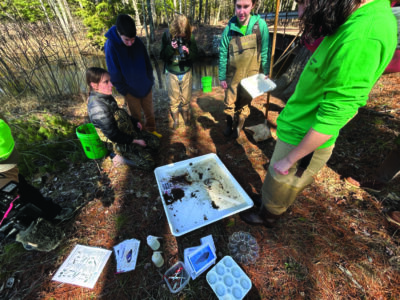
This year there were two ways to participate: by logging observations independently or by attending one of the Marquette City Nature Challenge events over the course of the weekend, such as a fungi walk and a night ecology event. Regardless of how people participate, they contributed to a valuable database of biodiversity.
"The value of participatory science goes beyond just its contributions of data and discoveries," said Owen VanAntwerpen, another NMU student organizer. "For me, the most valuable thing that citizen or participatory science can do is to make the scientific process feel more accessible and real, and to give people a push to look more closely at, and connect more deeply with, the world around them."
This year, local schools got involved, with events occurring in environmental and conservation biology classes at Marquette Senior High School and Negaunee High School. "In both of these classes, we will be taking the students on a walk around their respective campus to make observations," said Muscat. "We will be assisting the students in using iNaturalist to make these observations,” Muscat said.
"We wanted to work with the high schools for a couple of reasons. One being that we wanted to involve more of the community, and the other being that if we can get younger students interested in nature then they may be more conscious global citizens as they grow up."
While spring in Marquette County is only just beginning, there was still plenty to see.
"I know it still feels quite early in spring to be out looking for plants, mammals, birds, insects, fungi, and the like, but I think most people would be surprised at just how much biodiversity can be found locally at this time of year, even on a very short walk, or in the places we already frequent," said VanAntwerpen, who cited species of lichens, insects and migratory birds as examples of some of the organisms out and about in late April.
"We live in a time in which our environment, and the organisms which we share it with, are rapidly changing," said VanAntwerpen. "Gathering biodiversity data via citizen science efforts like the City Nature Challenge is an extremely versatile tool to understand these changes better -- to track the spread of invasive species, understand shifts in phenology and ranges of native species, and much more.
"Beyond this, it is all too easy, in an age where social media, news, and all the other responsibilities of life constantly demand our attention, to become disconnected from the living world around us, and the amazing assemblages of organisms with which we share it. The City Nature Challenge is one reminder and opportunity to reconnect, to look closer, to explore, and to learn, all while making valuable contributions to our scientific understanding of biodiversity."