
Copper Country Christmas: Communities support each other in difficult times
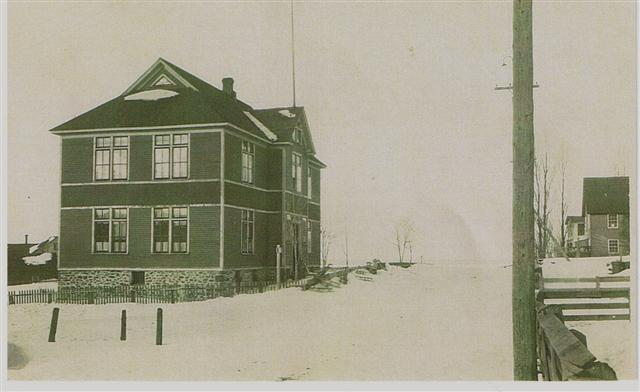
Photo via Stanton Township website The Redridge School, built in 1898, operated in Stanton Township until the E.B. Holman school was opened in Jan. 1973. The Redridge housed all eight grade levels until Dec. 1972, when the E.B. Holman School was opened in time for the beginning of the 1973 semester. During difficult times, such as the 1913 labor strike and the first five months of World War I, events like school Christmas programs and church functions were great contributors to the Copper Country retaining cohesion and a sense of security.
As the 1914 Christmas season approached the Copper Country global crises and economic instability weighed heavy on the region.
On Nov. 28, in an effort to quell rumors circulating through the Range towns, William Schaact of the Copper Range Consolidated Company published an announcement stating that no, the company had no plans to resume full-time production in December and workers would continue on a 15-day schedule.
The Annual Report of the company for that year stated:
“The reduction in output was effected by working the first half of each month and remaining idle the last half. The first shut down occurred August 15. When work was resumed September 1, wages were reduced from eight to ten percent. At the same time the salaries of all officials at the mines and eastern offices were cut twenty-five percent, and all these reductions continue throughout the balance of the year.”
The report of the Quincy Mining Co. indicates that the declaration of war in Europe caused a “curtailment and reduction in the working force.” Calumet & Hecla reported similar actions.
On Nov. 29, the Associated Charities of Hancock published an appeal to the public for assistance in meeting the needs of increasing poverty in the area.
The appeal reported that on the morning of the previous day, two organization committees’ investigations resulted in the authorization of immediate action.
One case involved a family that included nine children, the oldest of whom was 13 years, while the youngest was an infant twin whose brother had died the previous month. The children had eaten sparsely for weeks, the committee reported in the appeal, adding that crusts of bread and cold water is “about all the family has had” to subsist on.
“The father is a hard worker,” the appeal stated, “but has been working on half time, receiving $1.40 per day one week and a slight increase the next. Then for two weeks he is idle.”
That statement, while dramatic, raises questions.
The average work schedule under normal circumstances consisted of 26 days per month, with Sundays off.
At half-time, a month consisted of 13 days. At $1.40 per day the approximate total for that period was $18.20.
Meanwhile, the average cost of a 10-pound sack of rolled oats was 35 cents.
The appeal met with some success. After it was published, two fraternal organizations responded. The Hancock Eagles donated $25 and soon after, the Modern Samaritans donated $10.
The Associate Charities in their appeal reported findings based on investigations. The findings were reminiscent of charges made against many Western Federation members during the latter days of the strike of 1913.
“We find cases where men won’t work and cases where men can’t get work,” the Charities’ appeal stated. The problem in the first instance was that men refused to work as long as the family could receive assistance. The dilemma for the charity arose in the difficulty of how to provide aid to the wife and children without helping the head of the family.
Arthur Thurner, in his book Rebels on the Range: The Michigan Copper Miners’ Strike of 1913, wrote that social workers debated whether those willing to work should have to shoulder the burden of caring for the wants of those not working, since in nearly every case investigated, committees found the husband and father in health and able to work.
The officers of the WFM also found that as long as many strikers received strike benefits, they were more content to do nothing than contribute to ending the strike.
Faced with mounting debt, the union officials in Denver reduced strike benefits and cut striking miners who were also part-time farmers from receiving benefits. Denver officials reported on the speed at which the miner-farmers returned to working their farms.
While the front pages of the local papers contained the news on the war in Europe, and charities and part-time workers continued to struggle, Copper Country residents were steadfast in their determination to remember and keep the spirit of Christmas.
“A splendid Christmas program has been prepared by the pupils of the (Houghton) Canal school,” the Daily Mining Gazette reported on Dec. 15.
At the same time, at Pewabic Location on Quincy Hill, Cornish miners, legendary for their singing abilities, organized a carol choir to sing Christmas carols at the Pewabic Methodist Episcopal church on Dec. 20, in the morning and again in the evening, and sing on Main Street in Hancock on Christmas Eve.
On Dec. 16, the Redridge school conducted its Christmas program, which involved all eight grades.
Houghton’s municipal Christmas tree was set up near the bridge corner, decorated with lights under the direction of the superintendent of the Houghton County Electric Light Company.
In August, during the first weeks of the war in Europe, the local newspapers frequently contained articles that speculated on the thoughts and probable actions of immigrants in the Copper Country from the countries involved in the conflict.
By November articles of that nature had disappeared as the people of the copper region turned away from ethnic bias and focused on its being one community consisting of a diverse population of Copper Country residents. The Christmas season of 1914 only further cemented that belief.
Life
USS Liberty
Singing songs of praise
ESCANABA — An Escanaba women has advanced to the second round of the “You, God’s Music Showcase” — an ...

Half full: Mark Wilcox

Looking back: Graham Jaehnig

A Maze-ing artist