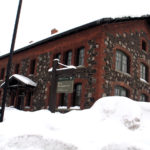
Carnegie Museum exhibit on woman suffrage
Exhibit open now until Mar. 28: Woman Suffrage
Petticoat Patriots: How Michigan Women Won the Vote, opened at the Carnegie Museum on Thursday, March 5, with a crowded and joyful reception. The exhibit, created by Michigan Women Forward of Lansing, was brought to the Copper Country by the LWVCC in cooperation with riseUP Keweenaw (Recognizing the Importance of women’s Suffrage Everywhere-UP). The exhibit tells the story of how, in 1918, Michigan women won their fight for the vote, followed by all American women achieving the vote in 1920, 100 years ago.
The exhibit is the work of Michigan Women Forward, formerly the Michigan Women’s Historical Center & Hall of Fame. The panels lay out the challenges and tactics that, for more than seven decades, were necessary to achieve woman suffrage in the United States. The Carnegie display supplements these materials with a collection of suffrage and women’s rights books, suffrage artifacts from the local community, and even a Votes for Women jigsaw puzzle.
The opening reception on Thursday, March 5, provided a program of celebration for the suffrage centennial. The reception opened with Faith Morrison of riseUP and the LWVCC reading the words of feminist scholar Gerda Lerner, a founder of the field of women’s studies, setting the stage for the suffrage battle: in the 1800s women had no civil rights to property, no rights to custody of their children, and were prohibited to speak in public, as this was considered indecent. Thus, the fight for suffrage began with a fight for women to have a public voice.
Following this introduction, Director of the Carnegie Museum (formerly the public library) Elise Nelson, welcomed attendees and noted that the original collection of the public library came from a local women’s library; also, the first librarian was a woman. Nelson turned over the program to a contingent of The Copper Country Chorale, who sang “The March of the Women,” a British suffrage anthem, written by composer Ethel Smyth. Smyth, a British composer, was prohibited from studying music by her father, and was only permitted to do so after staging an acrimonious two-year protest. Pianist William Keith contributed to the evening’s commemorations by playing a piece by Dvořák, a contemporary and acquaintance of Smyth’s.
The Suffrage Rally Singers were next in the program. Alice Margerum and Bill Fink, with technical assistance from Steve Walton, introduced us to the 1800s practice of “rally singing.” Getting a crowd to sing along to an anthem is a challenge, but 150 years ago they had an ingenious solution: set the words to a song familiar to the crowd. It worked on Thursday night as attendees sang along to two suffrage rally songs set to the tunes of “Oh Christmas Tree” and “The Battle Hymn of the Republic.”
The Friends of Fashion (Chassell) came to the reception bringing to life suffrage-fight leaders Alice Paul, Susan B. Anthony, and Mabel Vernon. Alice Margerum supplied members of the League with gold-white-purple sashes reminiscent of Alice Paul’s National Women’s Party tricolors used in the White House Silent Sentinel suffrage protests of 1917.
Petticoat Patriots will be on display in Houghton until Mar. 28. The Carnegie Museum’s hours are Tuesdays and Thursdays 12 to 5 p.m., and Saturdays 12 to 4 p.m. Educators who wish to bring a school group to see the exhibit outside of these hours may contact the Carnegie Museum directly to make arrangements.
Local News
In Brief: Wednesday
Keweenaw County Board meeting tonight EAGLE RIVER — The Keweenaw County Board of Commissioners regular May ...

Big Brothers Big Sisters honored
Setting it straight
Regarding an article in April 22, Daily Mining Gazette entitled "Help Wanted," the date for this year's Pitch in ...
In brief
Range Lions Club gives back SOUTH RANGE — At its April meeting, the Range Lions Club continued its tradition of ...
In brief
Garden Giveaway HOUGHTON–In honor of Houghton's effort to become the first Bird City in the Upper Peninsula, the ...